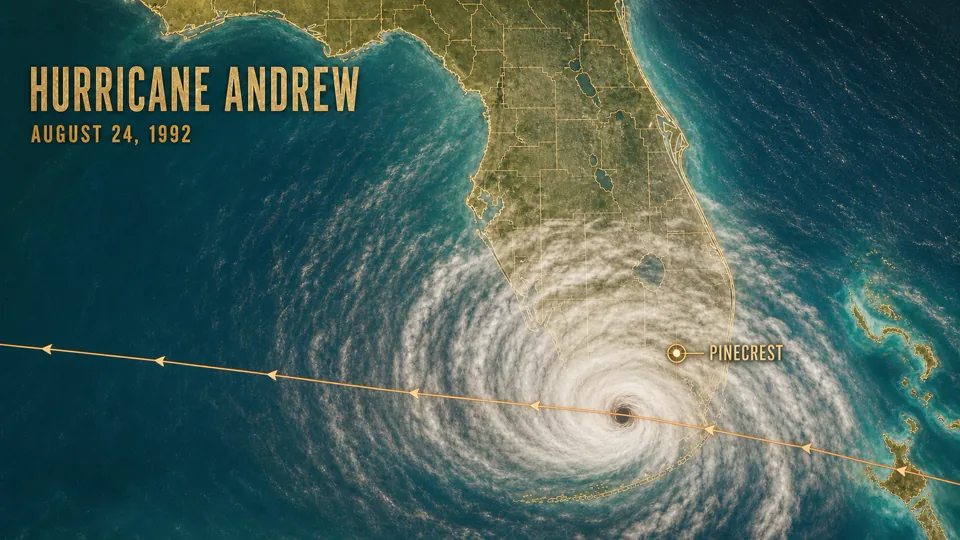
Hurricane Andrew and the case for a village
After Hurricane Andrew, Gary Matzner, Evelyn Langlieb Greer and their neighbors began asking whether Pinecrest could govern itself. By September 1994 more than 600 residents were meeting to discuss it.
The first organizing meetings
Hurricane Andrew devastated South Miami-Dade in August 1992 and left the region rebuilding for years. In the oral-history interview, Gary and Veronica Matzner describe the first Pinecrest incorporation discussions as coming out of that unsettled period: construction crews, burglaries, slow police response, and a sense that the area needed decisions made closer to home. They date the idea to fall 1993, which is consistent with the Herald’s 1996 accounts of when Greer and Gary began organizing.
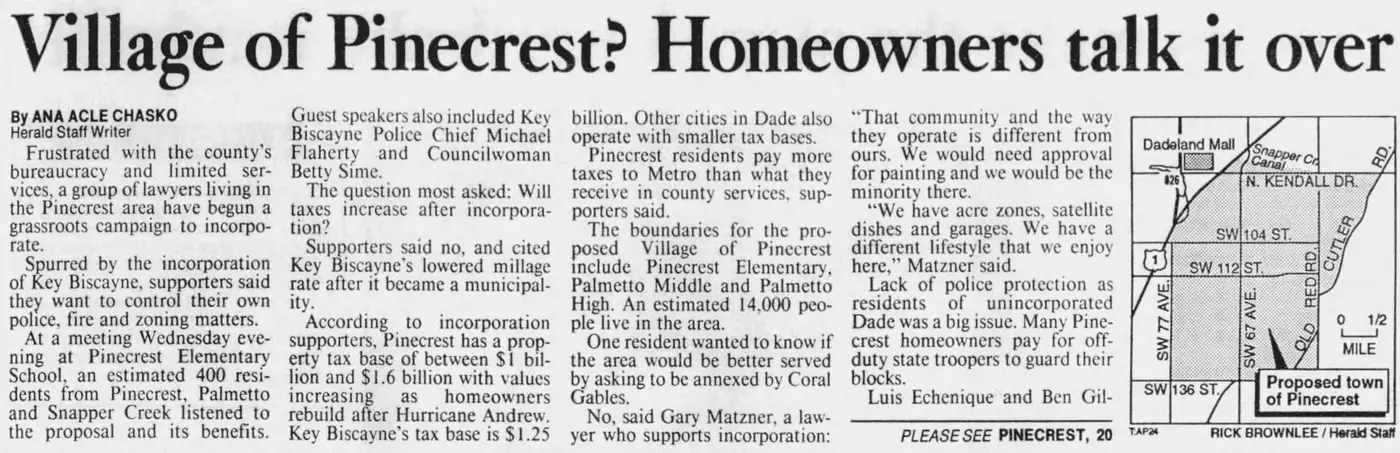
The oral history places one of the first organizing meetings at the Matzner home on March 9, 1994. Within weeks the idea was public. On April 24, 1994, the Herald reported that “a group of lawyers living in the Pinecrest area have begun a grassroots campaign to incorporate,” and that an estimated 400 residents of Pinecrest, Palmetto and Snapper Creek had come to Pinecrest Elementary School to hear the proposal. Guest speakers included Key Biscayne Police Chief Michael Flaherty and Councilwoman Betty Sime. The question asked most often was whether taxes would rise.
One resident asked whether the area would be better off annexed by Coral Gables. Gary said no: “We have acre zones, satellite dishes and garages. We have a different lifestyle that we enjoy here.” Evelyn Greer, described as another lawyer supporting the effort, explained the road ahead: a petition to the county, a county study of whether the area could stand alone, and finally a vote. A March 1996 Herald report credited Greer and Gary with getting things started “by gathering 600 signatures on a petition seeking incorporation.”
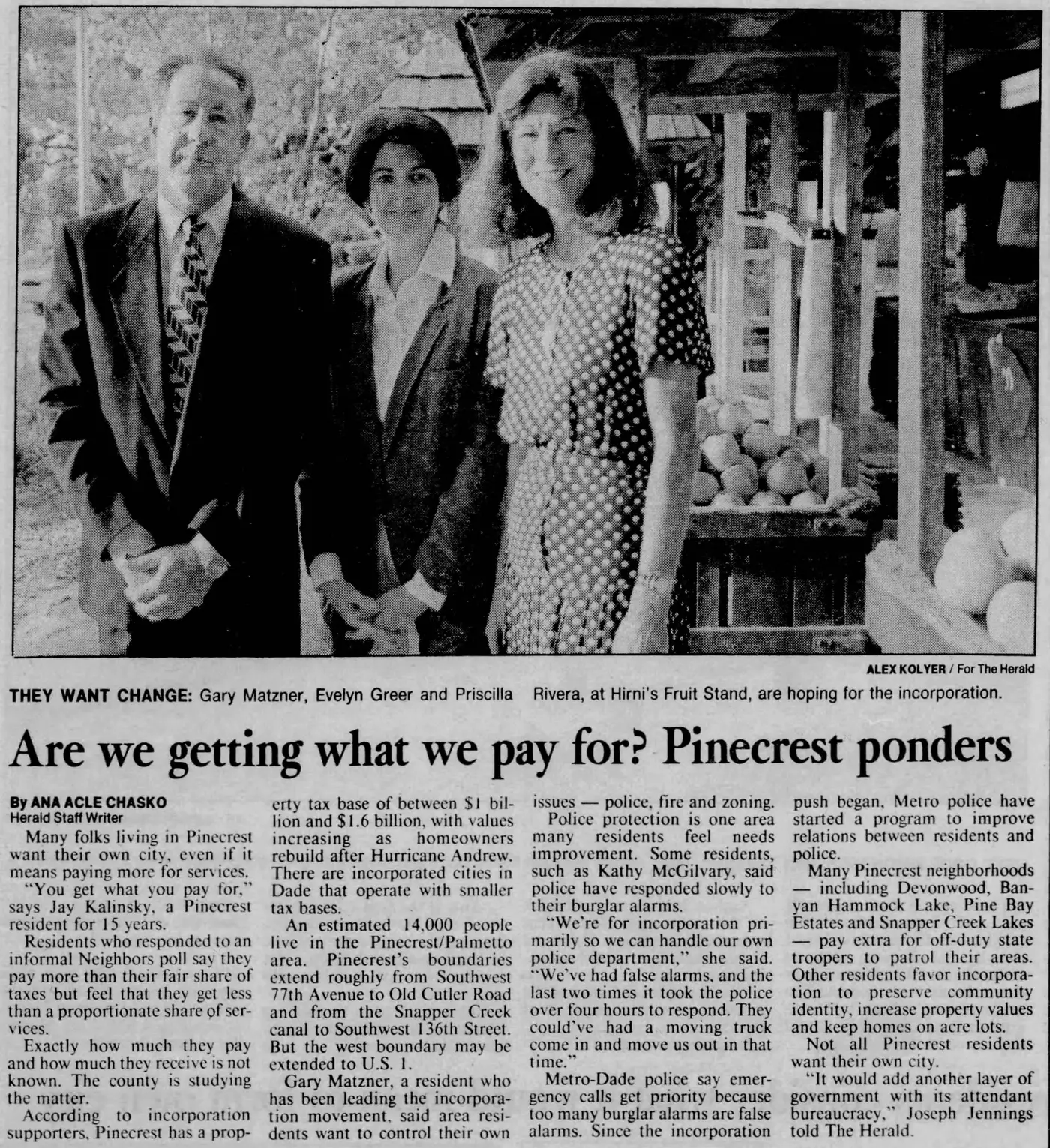
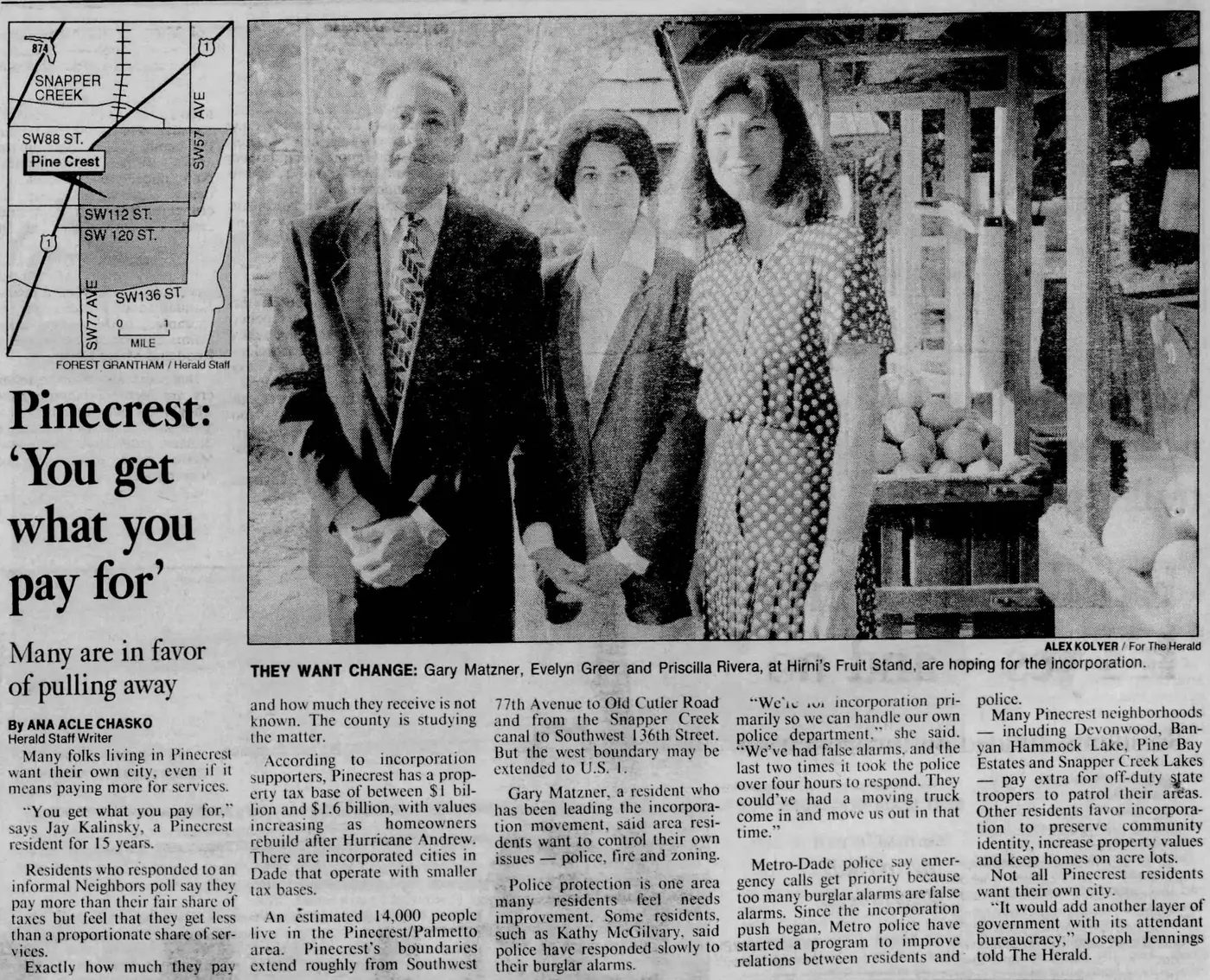
By summer the Herald was naming Gary as the movement’s leader. In July he explained why the first proposed map stopped short of the businesses along U.S. 1: “We were trying for a bedroom community. We just wanted some commercial area to put City Hall.” In August the paper photographed him with Evelyn Greer and Priscilla Rivera at Hirni’s Fruit Stand under the caption “THEY WANT CHANGE.” Residents gave their reasons. Kathy McGilvary said police had taken more than four hours to respond the last two times her burglar alarm went off; Metro-Dade police answered that emergency calls came first because so many alarms were false. Not everyone wanted a city. Joseph Jennings told the paper it “would add another layer of government with its attendant bureaucracy.”
On September 20, 1994, more than 600 residents met at Palmetto Middle School to discuss creating a city, a meeting the Village’s chronology describes as “advocated by incorporation leaders Evelyn Langlieb Greer and Gary Matzner.”
Village oral history 00:00-00:12; The Miami Herald, April 24, 1994, “Village of Pinecrest? Homeowners talk it over” (Ana Acle Chasko, 3K); July 28, 1994, “Residents fear being in middle” (Ana Acle Chasko, 5C); August 28, 1994, “Pinecrest: ‘You get what you pay for’” (Ana Acle Chasko, 29); March 10, 1996, “Pinecrest: To be or not to be a city?” (Charles Rabin, 3K); July 22, 2006, “What it took to make a village” (24WW)
“We were able to learn that we could have a very vibrant city and actually reduce our taxes to our residents.”
The case for a village
Supporters described Pinecrest as a donor community, one that sent the county more in taxes than it got back in services. In 1994 they put the area’s property tax base at between $1 billion and $1.6 billion. By the charter vote in 1996, advocates said Pinecrest’s 19,000 residents were paying $9.4 million in taxes and receiving $7.8 million in services, and the Herald cited a 1995 Metro study for a gap of about $1.6 million a year. Gary’s summary was direct: “We’re giving more than $1.5 million away. We’re a donor community, with excess taxes.”
The county’s numbers were the first test. At a meeting reported on March 2, 1995, county staff presented a feasibility study suggesting that Pinecrest might have to raise taxes. Gary said its per-capita method was misleading: the county had taken Key Biscayne’s fire costs, divided them per person and multiplied by Pinecrest’s larger population. “The reality is that Key Biscayne already bought those fire engines, and it wouldn’t matter if they increased their population,” he said. Greer called the study a “scare tactic.” The supporters had hired a consultant, Richard Henderson, whose theoretical budget suggested Pinecrest could increase its police force threefold without raising taxes. County budget analyst John Topinka stood by his department’s method: “It’s a standard measurement used by people in the business.”
Commissioner Katy Sorenson, the only county commissioner at that meeting, framed the question that would follow the campaign all year: “There’s no question the area could afford to incorporate if the community wants to. The question for me is what is the financial impact on the rest of the county?” Three days later a front-page Herald report listed Pinecrest among six communities considering incorporation and quoted Gary on the heart of the argument: “There’s no pride of community when you have 1.2 million people in a geographic area the size of Rhode Island. There’s no accountability.”
Gary helped prepare budgets, organize neighborhood meetings, and explain what a village could and could not do.
The Miami Herald, April 24, 1994; March 2, 1995, “To incorporation fans, numbers don’t add up” (Ana Acle Chasko, 3K); March 5, 1995, “The dash for incorporation” (Peter Slevin, 1A); March 10, 1996, “Pinecrest: To be or not to be a city?”; March 13, 1996, “Charter approval finalizes Pinecrest incorporation” (Charles Rabin, 2B); Village oral history 00:08-00:12, 00:30-00:38

Timeline, 1992–1994
-
Hurricane Andrew and a long recovery
The long recovery brought construction traffic, burglaries, and frustration with county response. In their oral history, Gary and Veronica describe that unsettled period as the background to the incorporation movement.
-
Gary studies incorporation
As neighbors considered privately funding off-duty police protection, Gary began asking why residents should pay twice. He studied Key Biscayne, Aventura, local tax capacity, and whether Pinecrest could support its own services. Herald reports in April 1996 dated the start of Evelyn Greer and Gary’s organizing to about two and a half years earlier.
-
An organizing meeting at the Matzner home
Gary and Veronica hosted an early organizing meeting at their home. The work moved outward from there into neighborhood meetings, school auditoriums, budgets, petitions, and repeated public explanations.
-
About 400 residents hear the proposal
The Miami Herald reported that a group of lawyers had begun a grassroots campaign to incorporate, and that an estimated 400 residents of Pinecrest, Palmetto and Snapper Creek came to Pinecrest Elementary School to hear it. Gary and Evelyn Greer were among the supporters quoted.
-
More than 600 residents meet at Palmetto Middle School
More than 600 residents met at Palmetto Middle School to discuss creating a city. The Village’s chronology names Evelyn Langlieb Greer and Gary Matzner as the incorporation leaders who advocated it.