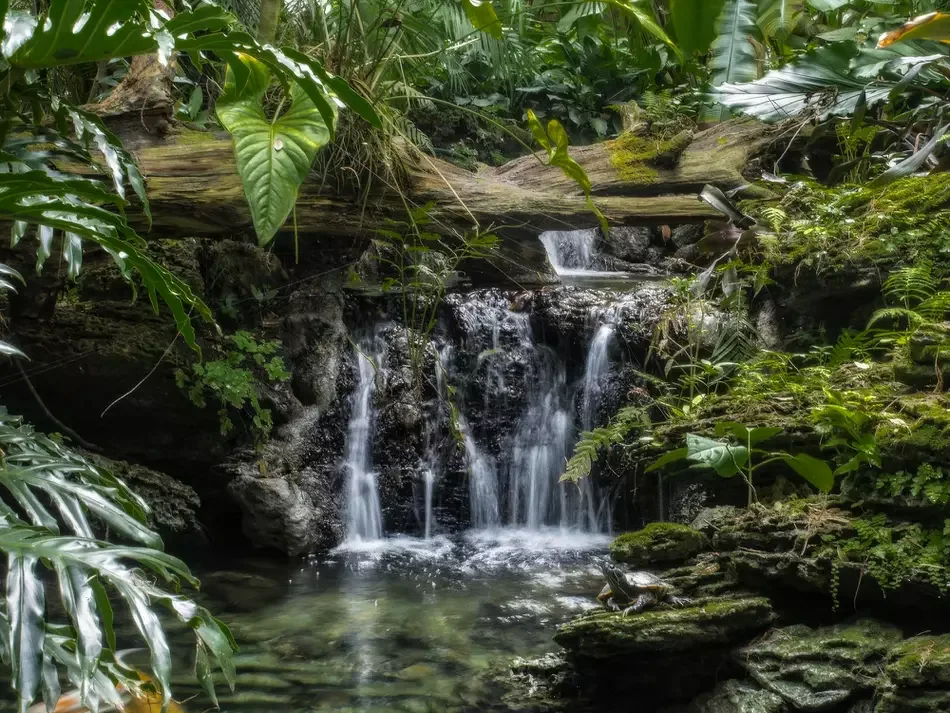
Parrot Jungle · Pinecrest Gardens
Saving Parrot Jungle
When Parrot Jungle prepared to leave its historic Red Road home, Pinecrest residents organized to keep the land a park. Gary Matzner founded their nonprofit, Preserve the Jungle. In 2002 the Village bought the property, and it became Pinecrest Gardens.
Pinecrest Gardens · Village of Pinecrest
The place
Parrot Jungle opened on Red Road in 1936
Parrot Jungle opened in 1936 at Red Road and Southwest 111th Street. Franz and Louise Scherr built paths and coral-rock structures through an existing tropical landscape, leaving much of the native vegetation in place and making free-flying birds the attraction’s signature. Recounting the site’s history in 2002, The Miami Herald wrote that Franz Scherr had leased the land in 1935 for $25 a month and that the attraction went on to draw visitors such as Winston Churchill.
The property’s hardwood hammock, cypress slough, limestone formations, remnant Snapper Creek streambed, natural waterways, caves, and fissures formed a rare landscape in the middle of metropolitan Miami-Dade. Generations of residents and visitors associated that landscape with Red Road and the community that later became Pinecrest.
Bern Levine bought the property in 1988. In 1994, after the county ruled that he could not build on about 10 unused acres at the property’s western edge, he sold that parcel to the developer Brookman-Fels for about $2.5 million. About a dozen luxury homes went up beside the jungle. When the City of Miami approved Parrot Jungle’s move to Watson Island in September 1996, residents feared they could lose the rest of the land as well.
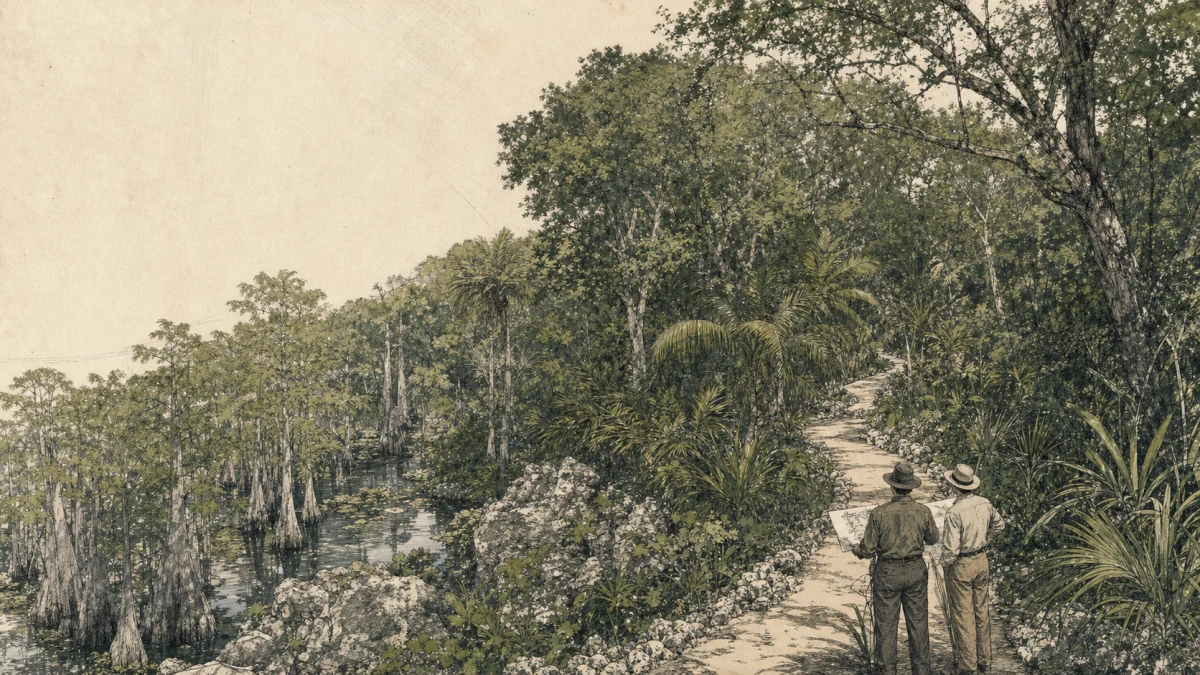
Preserve the Jungle · 1996–1998
A campaign for public ownership
Gary started Preserve the Jungle. His family remembers the group as his idea, formed in the Village’s first months, while the attraction’s future on Red Road was still unsettled. In 1998 the Herald described Gary, a Village founder, as having formed the group “right after Pinecrest incorporated.”
The group made its public debut that fall. On September 29, 1996, The Miami Herald reported that Preserve the Jungle had been formed “a little more than three months ago” by residents worried that the land would be sold to developers, and announced a first fundraiser at Fairchild Tropical Garden. “The event is to raise money so that ultimately, however it does get purchased, it will be left as a park,” member Robert Glowacki said. That November, Miami-Dade voters approved the Safe Neighborhood Parks bond, which set aside $4 million for the Parrot Jungle property, and the Herald later credited Preserve the Jungle with securing that allocation.
Gary was the group’s president and its public voice. In March 1997, with residents estimating the asking price at $8 million to $14 million, he was candid that the Village could not pay it alone. “The best of all worlds would be that we would get a matching grant,” he said. “Pinecrest isn’t going to be able to generate enough funds to buy the property.” The campaign was built on that idea: as his family recalls, Preserve the Jungle leveraged matching funds, so that what Pinecrest raised could be matched by larger public sources.
It was a neighborhood effort. The Herald’s photographs showed members including Councilman Leslie Bowe, Robert Glowacki, Lourdes Fanjul, and Natalie Lemos, later the group’s vice president. When a Coral Gables reader asked the paper where to send a donation, the editor pointed her to Preserve the Jungle and to Gary. By October 1997 the Herald called the group “the lone fund-raising voice for the village,” and when Mayor Evelyn Greer and the council formed a Parrot Jungle committee that fall, Preserve the Jungle became its fund-raising arm. Runners joined in too, at a Save the Parrot Jungle Run on Super Bowl Sunday in 1998.
The effort drew scrutiny as well as support. Councilman Barry Blaxberg pressed for the talks to take place in public. “The future of Parrot Jungle is too important to leave in the hands of a few,” he said in December 1997. Some residents questioned Gary’s motives, and Greer said no one, herself included, would profit from the purchase. By February 1998 the question before the young Village was whether to spend about $15 million on Parrot Jungle and Fowler’s Trailer Park. “I think the village is united in wanting to preserve Parrot Jungle as a park,” Greer said. Resident Kenneth Pollack said: “I think the village of Pinecrest has an obligation to get that property.”
The purchase · 2002
Pinecrest buys the land
The sale took four more years. In January 2002, with the Village expected to buy the site by the end of the year, more than 40 residents met at Pinecrest Park to imagine its uses, among them a library, a jogging trail, and a playground. “We have a gorgeous jewel sitting in the middle of our community,” resident Maria Elena Levrant said. “We have to start thinking of how we’re going to use it to benefit everyone.”
Through that summer visitors came for a final look at the attraction, which was preparing to reopen on Watson Island as Parrot Jungle Island. It closed on Red Road on December 1, after crews had moved hundreds of trees and shrubs to the new site, and the Village completed the purchase on December 17, 2002.
The money came from several sources, the matching structure the campaign had aimed for. Florida Communities Trust records list a 13.38-acre Pinecrest Parrot Jungle project with a $2.2 million state grant and a local match of about $5.84 million, for a total of about $8.04 million. The Herald later reported that the county’s $4 million in bond money and the state grant were applied to the historically designated core of about 14 acres, and that the Village used its own funds for the adjoining six-acre and two-acre parcels.
In 2005 the Herald wrote that Gary “helped raise $4 million for the village to buy the park,” and a 2018 Temple Judea profile put the amount at more than $4 million. Elsewhere in the Herald’s reporting, $4 million is the county bond allocation it credited Preserve the Jungle with securing. Private donations, county bond money, the state grant, and Village funds were separate sources, and published accounts differ on which of them the $4 million describes.
Pinecrest Gardens
Parrot Jungle became Pinecrest Gardens
Pinecrest Gardens was dedicated as a municipal park on March 8, 2003. That week the Herald announced a free opening celebration led by Mayor Evelyn Greer, with a ribbon-cutting at Flamingo Lake, school bands, and a children’s theater production in the Banyan Bowl. Its historic entrance, tropical garden, waterways, coral rock, and original landscape remain part of a public place used for arts, recreation, education, markets, and community gatherings.
Gary had helped save the land, and as mayor he made it free to visit, one of his campaign promises. In November 2004, weeks into his first term, he proposed eliminating the admission fee, then $5 for adults. “The Gardens are a hidden treasure, and I hate to see it go to waste,” he told the council. “Basically, the entrance fee is a barrier to entry for the community.” Councilman Robert Hingston agreed, and in December the council made general admission free, charging only for special events and programs.
Attendance grew. In May 2006 the Herald reported that fewer than a dozen people a day had visited on average in 2004, compared with about 150 on weekdays and 500 on weekend days by 2006. Gary called the Gardens the “gem” of the village. “Particularly since we don’t have a downtown,” he said, “this is our equivalent of our downtown.” When a resident suggested that fall that the Village sell the Gardens to lower taxes, Gary called the park a “treasure” and “asset” to the community.
The council, Village staff, and a new Gardens foundation took up larger plans: a restaurant, a renovated Banyan Bowl, and a two-story library and community center on Village land beside the garden, built in partnership with the Miami-Dade Public Library System. At the library groundbreaking in September 2006, Gary quoted Cicero: “If you have a garden and a library, you have everything you need.” Hurricanes, rising costs, and a change of contractor delayed the work. Gary cut the ribbon when the community center was dedicated on May 31, 2008, and the library was scheduled to open that October. In August 2008 he appointed a committee to study the Banyan Bowl as a performing-arts venue.
Pinecrest Gardens is the original Parrot Jungle property on Red Road; the attraction itself moved to Watson Island. Gary C. Matzner Park, on North Kendall Drive, is a separate Village park that bears Gary’s name.
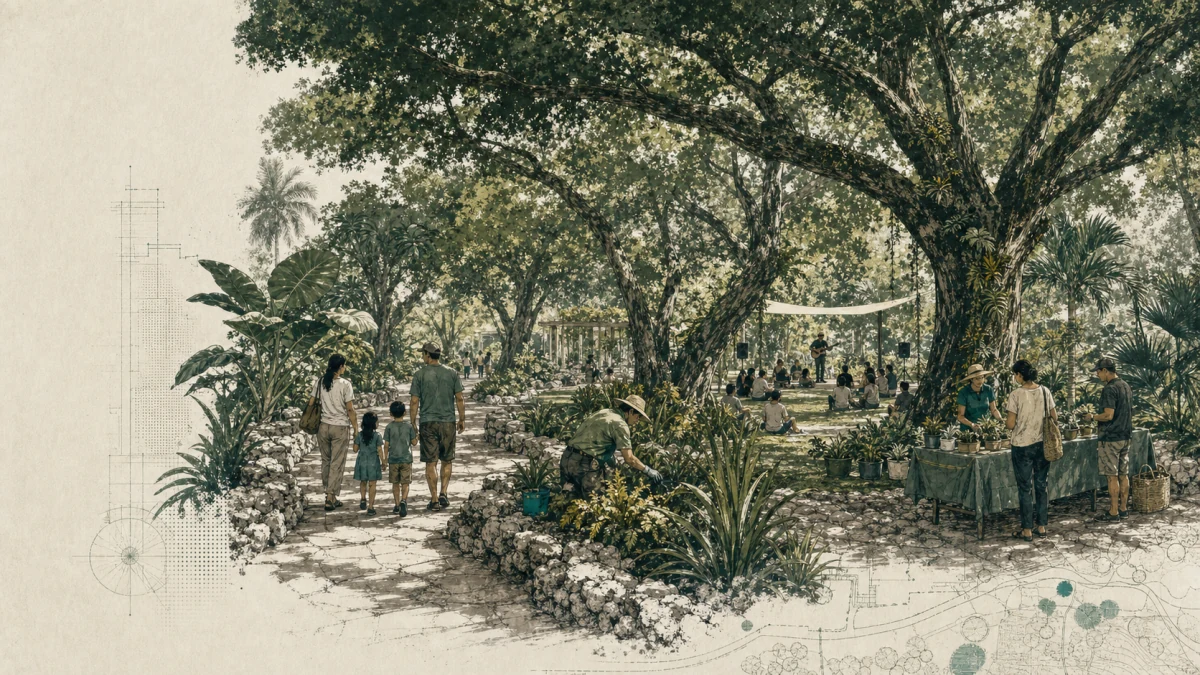
From attraction to public garden
The preservation story, 1936 to 2008
-
Parrot Jungle opens on Red Road
Franz and Louise Scherr opened an attraction built around free-flying birds, coral-rock paths, native hammock, tropical planting, and the site’s natural water and limestone features.
-
Part of the property becomes homes
After the county ruled that owner Bern Levine could not build on about 10 unused acres at the western edge, he sold that parcel to the developer Brookman-Fels for about $2.5 million. About a dozen luxury homes were later built beside the attraction.
-
Gary founds Preserve the Jungle
Gary started the nonprofit, according to his family, to raise money and public support for buying the land. On September 29, 1996, The Miami Herald reported the group had formed “a little more than three months ago” and announced its first fundraiser at Fairchild Tropical Garden. In 1998 the Herald wrote that Gary had formed the group “right after Pinecrest incorporated.”
-
County voters set aside $4 million
Miami-Dade voters approved the Safe Neighborhood Parks bond, which earmarked $4 million for acquiring the Parrot Jungle property.
-
The Herald names Gary president
The Herald identified Gary as the group’s president and reported his hope that a matching state or county grant would make the purchase possible. Residents then estimated the asking price at $8 million to $14 million.
-
The Village forms a Parrot Jungle committee
In October the Herald called Preserve the Jungle “the lone fund-raising voice for the village.” Councilman Leslie Bowe then chaired a 10-member Village committee to plan the property’s use and help find purchase money. Gary was among the nine residents appointed, and Preserve the Jungle was named its fund-raising arm.
-
Pinecrest weighs the cost
Village officials debated whether to spend about $15 million on Parrot Jungle and Fowler’s Trailer Park, and postponed a $10 million Florida Communities Trust grant application to allow more time for public input. The Herald reported that Gary had left the Village committee after two weeks to return to his private group, that Councilman Barry Blaxberg and a small group of residents had questioned his motives, and that committee member Bruce Wilner had asked members to sign affidavits swearing they had no material interest in the acquisition.
-
The Village completes the purchase
The attraction had closed on December 1 ahead of its move to Watson Island, and on December 15 the Herald reported the Village was days from closing a $12.5 million purchase. Florida Communities Trust records list the 13.38-acre Pinecrest Parrot Jungle project as closed this day, with a $2.2 million state grant and a local match of approximately $5.84 million.
-
Pinecrest Gardens is dedicated
The former attraction reopened as a municipal park. The Village announced a free celebration led by Mayor Evelyn Greer, with a ribbon-cutting at Flamingo Lake and a children’s play in the Banyan Bowl.
-
Critics question the county’s share
The Herald reported that the county’s share had been reduced from 22 acres to fewer than 14 while its $4 million contribution stayed the same, and described the new park as “all but empty most days” while visitors paid a $5 admission fee. Greer defended the memberships as necessary to raise money. The report identified Gary as the head of Preserve the Jungle, which was raising money for the park.
-
The admission fee ends
Weeks after Gary took office as mayor, the Village Council approved his proposal to drop the Gardens’ general admission fee, keeping fees only for special events and programs. He had raised it in November; the council asked for more research, including how to treat annual members, before voting in December.
-
The community center opens
Gary cut the ribbon at the Pinecrest Community Center beside the Gardens. The adjoining branch library, built with the Miami-Dade Public Library System, was scheduled to open that October.
Sources
Newspaper, Village, state, and landscape records
Village, state, and landscape records
Pinecrest Gardens historyOpening, Village purchase, and municipal-park dedication The Cultural Landscape FoundationHistoric landscape, architecture, hammock, cypress, and public-park history Florida Communities Trust annual reportAcquisition acreage, grant, local match, total cost, and closing date Temple Judea presidency profilePreserve the Jungle leadership and fundraising record, as reported in 2018 Village oral historyGary and Veronica Matzner’s first-person account of the preservation effortThe Miami Herald
The Miami Herald, September 29, 1996“Group aiming to buy old Jungle land,” Charles Rabin, page 34N The Miami Herald, March 16, 1997“Figuring out who will be king of the jungle,” Charles Rabin, pages 1C and 14C The Miami Herald, March 30, 1997“How to preserve Parrot Jungle?,” reader letter and editor’s note, page 23C The Miami Herald, October 2, 1997“Group to evaluate Parrot Jungle site,” Charles Rabin, page 7K The Miami Herald, December 7, 1997“Group will consider fate of Jungle land,” Charles Rabin, pages 3K and 14K The Miami Herald, January 11, 1998“Save The Parrot Jungle Run,” public service announcement, page 12K The Miami Herald, February 19, 1998“Pinecrest ponders: Should we spend?,” Charles Rabin, pages 1C, 8C and 9C The Miami Herald, January 10, 2002“Park’s future sought,” Eunice Sigler, pages 3E and 6E The Miami Herald, August 25, 2002“Parrot Jungle fans flock to park for a final look,” Eunice Sigler, page 50W The Miami Herald, December 14, 2002“A jungle first, then the parrots,” Elinor J. Brecher, pages 1B and 2B The Miami Herald, December 15, 2002“Village critical of Parrot Jungle,” Eunice Sigler, page 6NC The Miami Herald, March 6, 2003“Event to open Pinecrest park,” page 24E The Miami Herald, October 26, 2003“Critics: Park hijacked for rich,” Joe Mozingo, pages 1B and 5B The Miami Herald, November 14, 2004“Village may drop park entrance fee,” Kevin Dean, pages 3C and 18 The Miami Herald, December 12, 2004“Admission fee is eliminated,” Kevin Dean, pages 3E and 10E The Miami Herald, June 2, 2005“Gardens may house restaurant, ampitheater,” Yudy Pineiro, page 3PP The Miami Herald, May 28, 2006“Best of times lie ahead for popular park,” Kathleen Fordyce, pages 8GS and 12GS The Miami Herald, October 1, 2006“Ground broken on leisure library,” Kathleen Fordyce, page 3PP The Miami Herald, October 1, 2006“Funds budgeted for park, library and new center,” Kathleen Fordyce, page 4PP The Miami Herald, July 13, 2008“A Place to Gather,” Ric Hernandez, page 21SD The Miami Herald, August 17, 2008“Banyan Bowl could be an arts venue,” page 2PP The Miami Herald, August 31, 2008“Library will be beacon for learning,” Priscilla Greear, pages 6GS and 40GS