The campaign and the 1995 vote
In 1995 the incorporation committee settled Pinecrest’s boundaries, won the county’s permission to hold a vote, and campaigned against organized opposition. On September 19, voters approved cityhood by nearly two to one.
Drawing the boundaries
Where Pinecrest would end was argued street by street. The maps printed during the campaign show proposals that differ from the Village’s present limits. In July 1994, residents of a triangle between Southwest 77th Avenue and U.S. 1 worried they would be stranded between a new Pinecrest and a new Kendall. Gary told the Herald the homes would likely be added, because “the county won’t let us leave people in a legal limbo.”
In March 1995 South Miami floated an annexation plan that overlapped Pinecrest’s proposal; Gary, then on the incorporation steering committee, said the committee had never considered joining South Miami. In April the steering committee pulled the southern line north so that Palmetto residents could pursue a city of their own. “It’s to accommodate the wishes of the residents of the Palmetto area who wish to have a right to self-determination,” Gary said, adding that the new lines followed the Pinecrest Elementary school district. The western edge was pushed out to take in residents who feared being left out of every proposal. The lines kept moving: by the September vote, Herald reports again described Pinecrest as running south to Southwest 136th Street.
The last disputes came after the vote. Pine Bay Estates, Snapper Creek Lakes and Cutler Bay/Deering Bay wanted to join Coral Gables instead, and in early November 1995 Metro commissioners voted 6-4 to delay creating Pinecrest for two weeks. Coral Gables City Manager Jack Eads explained the problem: “We can’t make a binding decision with just well-meaning folks.” Gary said the charter would give the neighborhoods up to a year to leave if they chose. The compromise approved later that month let Pine Bay Estates, Snapper Creek Lakes and Hammock Lakes vote on joining the Gables. “Since they weren’t yet in Coral Gables, they had to be included in Pinecrest, otherwise an enclave of unincorporated Dade would have occurred,” Gary said.
In December, after Cutler Bay residents told the County Commission they would rather stay, commissioners ended that neighborhood’s bid to join Coral Gables. “Coral Gables is a great city, and for people to want to choose Pinecrest instead gives us great confidence,” Gary said.
The Miami Herald, July 28, 1994, “Residents fear being in middle”; March 12, 1995, “S. Miami eyes grab for land” (Gregory R. Chin, 12C); April 30, 1995, “‘City limits’ for Pinecrest are redrawn” (Ana Acle Chasko, 8C); November 9, 1995, “Metro delays creation of Pinecrest” (Ana Acle Chasko, 3K); November 26, 1995, “Pinecrest taking shape as a city” (Ana Acle Chasko, 3K); December 28, 1995, “Cutler Bay area to stay in Pinecrest” (Ana Acle Chasko, 3K)
“And he’s like, we need everybody to be on board or it’s not going to happen.”
Winning the county’s permission to vote
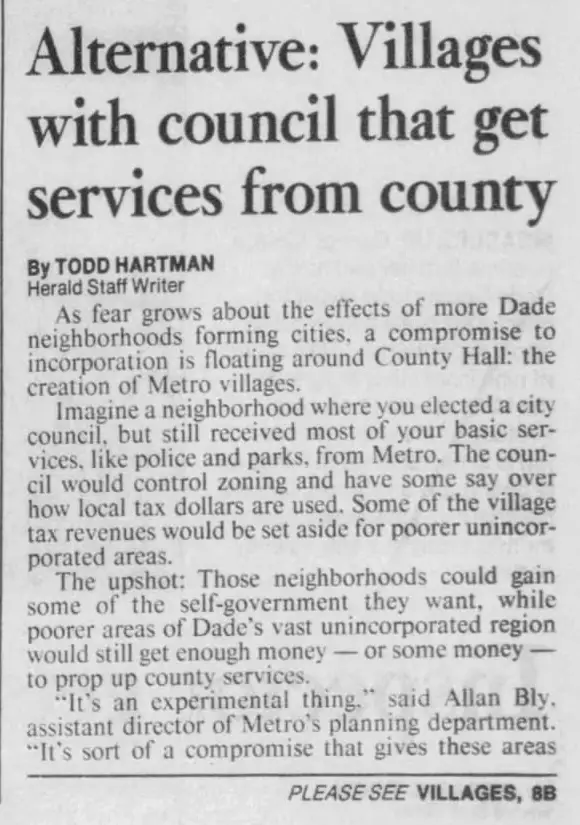
Metro-Dade faced incorporation drives in Aventura, Destiny, East and West Kendall and other communities at once, and county leaders worried that affluent areas would leave poorer neighborhoods without enough money for services. In April 1995 county planners floated “Metro villages”: elected councils that would control zoning but keep buying most services from the county. Gary rejected the idea: “We view these ‘quasi-cities’ as merely second-class entities, which will again be controlled and dominated by the County Commission.”
In June 1995 the Metro Commission set September 19 as the date for Pinecrest’s vote, the same day as Destiny’s, while warning that it was not a done deal. Gary told commissioners the community did not want to hurt county government: “The only thing we’re asking for is those city-type services that elude us today.” Greer called the coming July policy hearing “the showdown at the OK Corral.”
The summer brought three more challenges. The county Planning Advisory Board recommended a countywide revenue-sharing plan before any new city formed; Gary said Pinecrest already had approval to vote: “We followed the rules, and it’s my understanding that they’re going to let us go.” A county-commissioned Florida International University poll found that only about one in five residents of unincorporated Dade favored forming new cities, with support soft even in Pinecrest. Gary answered that he and other leaders had collected about 2,000 signatures and had the backing of 20 neighborhood groups. Then County Manager Armando Vidal proposed delaying every pending incorporation and requiring new cities to have at least 50,000 residents. Gary called them “Goldilocks Cities” and asked, “What’s he saying, ‘Coral Gables is too small to be a city?’”
The September vote stayed on the calendar. In the oral history, Gary describes county concerns about revenue, police-union pressure, and the need to keep the Pinecrest campaign moving while other communities pressed their own cases.
The Miami Herald, April 23, 1995, “Alternative: Villages with council that get services from county” (Todd Hartman, 1B); June 9, 1995, “Metro to allow Pinecrest to vote on whether it will become a city” (Todd Hartman, 2B); June 29, 1995, “Will county approve revenue sharing?” (Ana Acle Chasko, 3NC); July 12, 1995, “Dade poll challenges case for secession” (Dexter Filkins, 1A); July 13, 1995, “Vidal: Slow plans for creating cities” (Todd Hartman, 8A); Village oral history 00:16-00:49
The final campaign
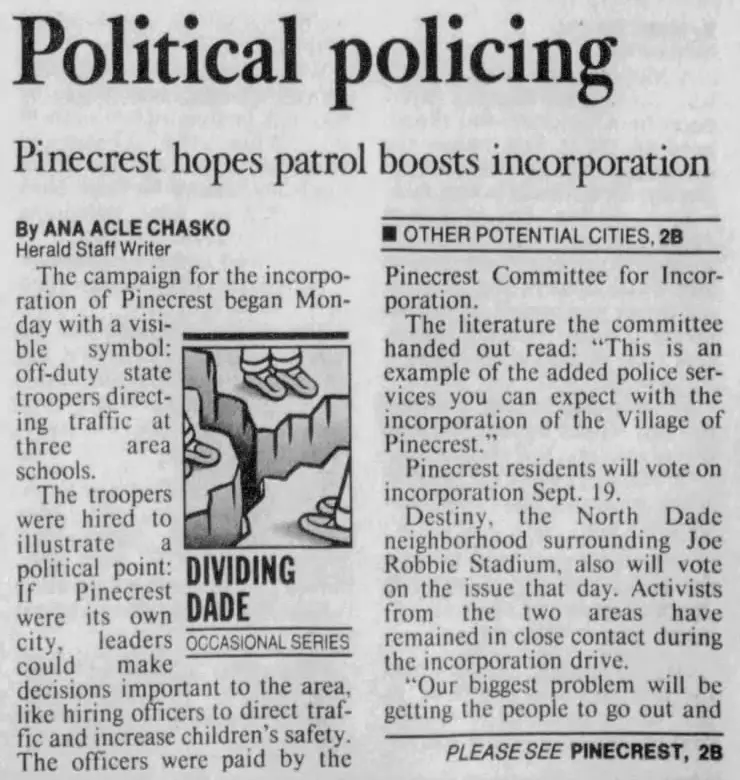
The Pinecrest Committee for Incorporation opened its final push on the first day of school in August 1995. It paid off-duty state troopers to direct traffic at Pinecrest Elementary, Palmetto Elementary and Palmetto Middle, and handed out literature that read: “This is an example of the added police services you can expect with the incorporation of the Village of Pinecrest.” Gary, wearing a button that read “Vote for Pinecrest Sept. 19,” named the real worry: “Our biggest problem will be getting the people to go out and vote.”
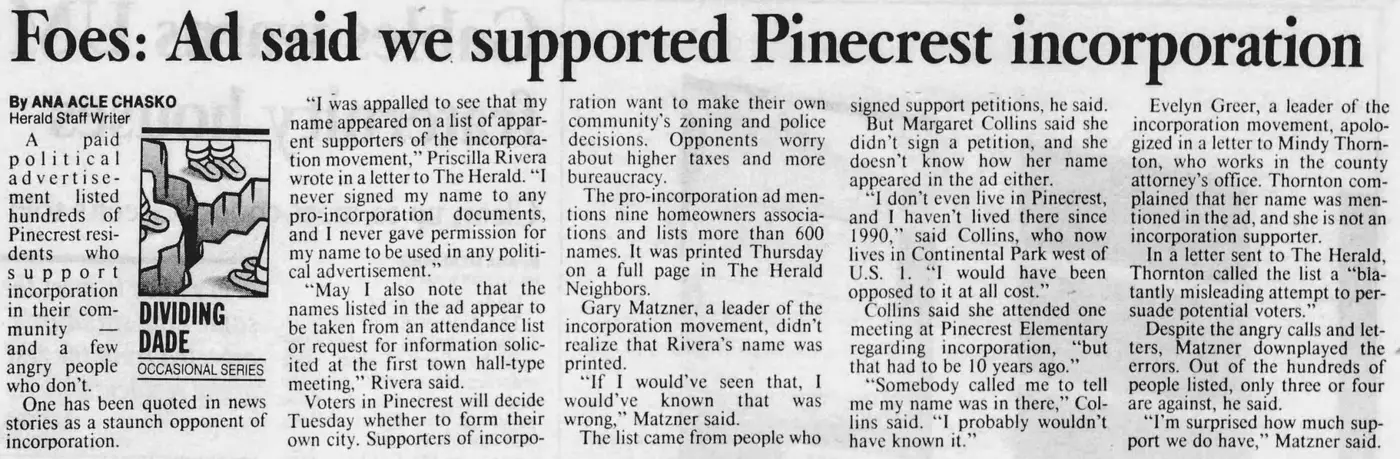
Campaign reports showed the committee had raised $8,515 from 16 contributors in two months, including three homeowners associations, and had spent $7,728, mostly on mailings. Gary said volunteers would answer questions at shopping centers, mail pamphlets and advertise in newspapers. A full-page advertisement listed more than 600 supporters and nine homeowners associations, but several people said they had been listed without permission. Gary said the names came from support petitions and acknowledged the mistake: “If I would’ve seen that, I would’ve known that was wrong.” Greer apologized in writing to one of those listed.
Organized opposition appeared a week before the vote. The Police Benevolent Association prepared a pamphlet for Pinecrest homeowners arguing that crime was falling and response times improving, and police officials warned that incorporations across the county could cost Metro officers their jobs. Kendall attorney Richard Friedman sent business owners on U.S. 1 fliers predicting higher taxes. Gary answered the police union directly: “We have never said police don’t do a good job. We never had a bone to pick with them. The problem is that they’re not there.”
The Miami Herald, August 29, 1995, “Political policing” (Ana Acle Chasko, 1B); August 30, 1995, “Hired cops make a political point” (Ana Acle Chasko, 3B); September 10, 1995, “Police group attacks Pinecrest vote” (Ana Acle Chasko, 3K); September 14, 1995, “Pinecrest advocates raise $8,515” (Ana Acle Chasko, 12C); September 17, 1995, “Foes: Ad said we supported Pinecrest incorporation” (Ana Acle Chasko, 3K)
The September 1995 vote
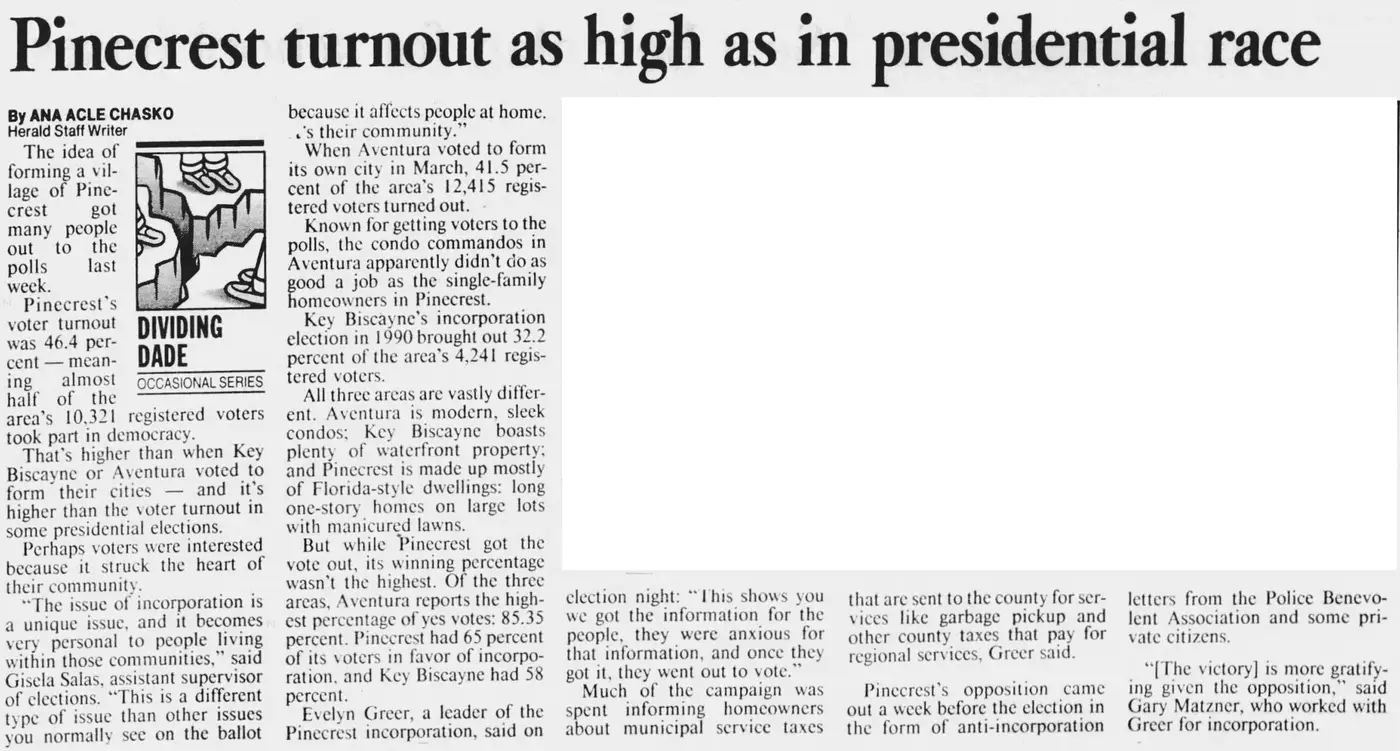
Pinecrest voters approved incorporation 3,138 to 1,623, according to the Village’s chronology; the Herald reported about 65 percent in favor. Turnout was 46.4 percent of 10,321 registered voters, higher, the Herald noted, than in the incorporation elections in Key Biscayne or Aventura. The same day, voters in Destiny, the North Dade community whose activists had stayed in close contact with Pinecrest’s, rejected cityhood.
That night Gary spoke about service: “It’s not an issue of rich or poor, or white or black. It’s an issue of providing better services for tax dollars.” He predicted that neighboring communities would notice “police out on the streets in Pinecrest, taxes going down, potholes getting fixed and more school crossing guards.” Greer credited the information campaign: “This shows you we got the information for the people, they were anxious for that information, and once they got it, they went out to vote.” Metro planning director Guillermo Olmedillo was doubtful: “My gut feeling is that to maintain the same level of services, they will have to raise taxes.”
The vote did not yet create a village. Metro still had to appoint a charter panel, Pinecrest voters still had to approve a charter, and, as the Herald noted, county commissioners could kill the plan at any point along the way.
Village Clerk milestones; The Miami Herald, September 20, 1995, “Voters split on cityhood” (Sabrina Walters and Ana Acle Chasko, 1A); September 20, 1995, “Split decision in Dade vote on new cities” (2B); September 24, 1995, “Pinecrest turnout as high as in presidential race” (Ana Acle Chasko, 3K); July 22, 2006, “What it took to make a village”
In the Miami Herald, 1995
All 23 articles from these years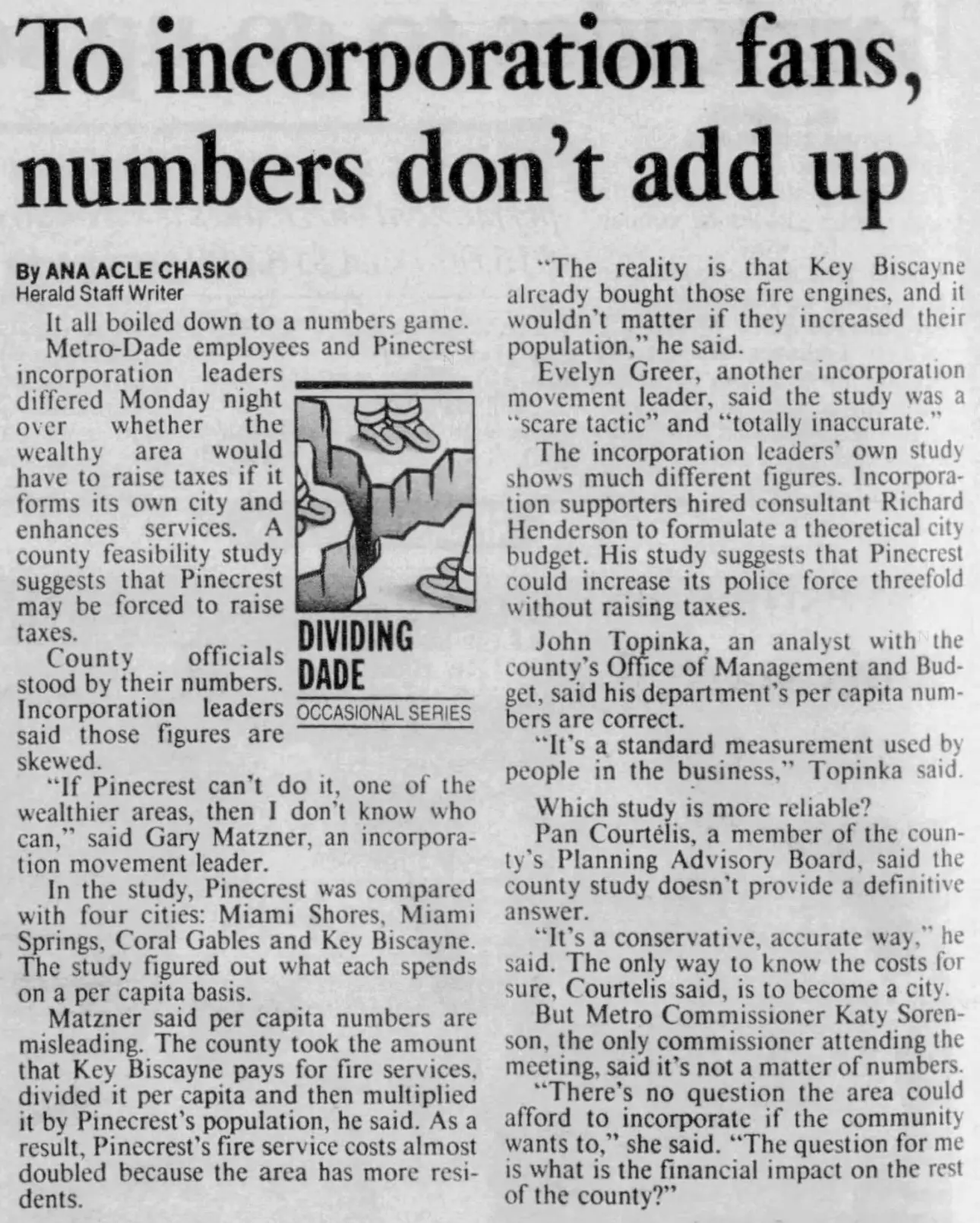

Timeline, 1995
-
Metro sets a date for the vote
Metro commissioners agreed to let Pinecrest vote on September 19, while warning that the fight over how new cities would affect poorer parts of the county was not over. Gary told the commission the movement wanted only “those city-type services that elude us today.”
-
Pinecrest votes for cityhood
After county review, boundary negotiations, and a late opposition campaign by the police union and others, Pinecrest-area voters approved cityhood by 3,138 votes to 1,623. Turnout was 46.4 percent. Destiny, in North Dade, rejected cityhood the same day.