A village in time
Pinecrest's early residents recall a time when kids played in the woods and windows were blacked out to avoid the German navy's notice.
Label: Pinecrest
Deck
Pinecrest’s early residents recall a time when kids played in the woods and windows were blacked out to avoid the German navy’s notice.
BY MICHELLE HAMMONTREE-GARCIA [email protected]
Joyce Diehl is one of Pinecrest’s pioneers.
She is 93.
She lived on 7 1/2 acres in a ranch-style house her late husband built in 1947 surrounded by avocado, grapefruit and orange groves. Her memory of those early days is aided by albums of black-and-white photos that show pristine land with pines and palmettos towering as far as the eye can see.
Diehl is one of about 100 seniors over 90 and one of 600 seniors over 80 who live in the 7.5-square-mile village. These early descendants of Pinecrest have lived through World War II and an industrial boom and have seen their once rural patch of land become one of South Florida’s more exclusive neighborhoods.
Joy Parrish, 79, remembers taking a school bus to Perrine Elementary in 1940. “There was one school bus and one route. We would travel for miles before we would pick up another girl by Chapman Field and then another on Old Cutler Road, and finally got to the school in Perrine,” Parrish said.
Today, the norm is one-acre lots in Pinecrest, whose population has climbed to about 19,000. The village borders U.S. 1 on the west, Red Road to the east, Kendall Drive on the north and Southwest 136th Street to the south.
Pinecrest incorporated on March 12, 1996, making it the 29th municipality in the county. Evelyn Greer and Gary Matzner led the incorporation effort. Greer was the village’s first mayor, Matzner, the second. Mayor Cindy Lerner is the third.
Diehl wouldn’t have imagined that the place she called Forest Garden would be 98 percent built today. At 29, when she heard that a neighbor named “Ole Mr. Goode” wanted to subdivide his five acres, she rode her bicycle around the neighborhood collecting signatures against it.
“We’d go from door to door. There were just a few homes. But then we’d stop cars that were coming in and have them sign [a petition],” said Diehl, who now lives in a home on a one-acre lot. “He wanted half-acres, and we were against that. We thought it would be nice to leave it country-like.”
In 1942, German submarines lurked off the waters of Matheson Hammock Park in Coral Gables. Parrish was 11 at the time and lived in a house that her father, an air-raid warden, had built off of Southwest 77th Avenue and 122nd Street.
“In 1943, U-boats were responsible for the torpedoing of 25 ships off Florida’s east coast between Key West and Daytona Beach,” wrote Howard Kleinburg in the book Miami, The Way We Were.
Parrish remembers blacking out the light streaming from the doors and windows with black cloth and her father painting car headlights black.
“The war was that close. We didn’t want to get shot at,” she says now.
She and her two sisters peeked at the Germans who were held at a prisoner-of-war camp across from U.S. 1, where Dadeland Station is today.
“U.S. 1 was narrow in those days. We could see these handsome men exercising,” said Parrish, the youngest of three sisters.
The trio also caught glimpses of the German prisoners swimming at Matheson Hammock as part of their exercise routine.
“There was a very high diving board with three sections in Matheson Hammock Park. [The Germans] would do some magnificent flips. So handsome they were. We were never scared of them but never got too close, either.”
In the mid-1950s, 10 years after the war ended, the population of Dade County boomed. In 1940, there were 260,000 residents. By 1962, there were one million, said Dr. Paul George, a South Florida historian.
Arthur Vining Davis, who was the chairman of the Aluminum Company of America and its largest stakeholder, made developing the suburbs of South Miami-Dade possible through his philanthropy.
“He owned thousands of acres in deep South Dade and donated the land to build the Palmetto Expressway, Baptist Hospital, expand U.S. 1 and build Kendall Drive,” George said.
Joe and Ann Howell bought an acre lot in the 6800 block of Southwest 90th Street in 1956 for $4,125, an area covered by tomato fields. Joe, who made a living as a mason, built the L-shaped house where he and Ann raised six children. Recent development “took away the wildlife refuge” in the woods, where the children played among owls, rabbits, foxes and skunks.
“It was beautiful seeing those big trees out there,” Joe said.
Since the Howells built their “dream home” 56 years ago, development has encroached. An apartment complex now abuts the northwest side of their property, and a 6,300-square-foot house built in 2002 towers over the east side, according to the Miami-Dade County property appraiser’s office.
A dirt road leads up to the Howells’ property, where they once kept horses and chickens and Ann tended to a vegetable garden. A two-story-tall verdant wall on the south side is the only hint left of the area’s vast wooded landscape.
“We don’t have central air - we never have. It was so cool because the trees cooled the air, and then gradually they started building and it got hotter so we put fans in,” said Ann, 80, a pianist who volunteers at her church, South Miami Heights Church of the Nazarene in Cutler Bay.
Today, one of their neighbors is considering splitting her acre lot and is lobbying for an access road to be built that would do away with the Howells’ verdant south-side barrier.
“Two [houses] on an acre is too much, I think,” Ann said.
“That is the old folks’ view, you know. The young folks don’t look at it like that,” said Joe, 85, who is known to perform impromptu violin concerts in his yard and speaks fluent Spanish and Portuguese.
Photographs And Captions
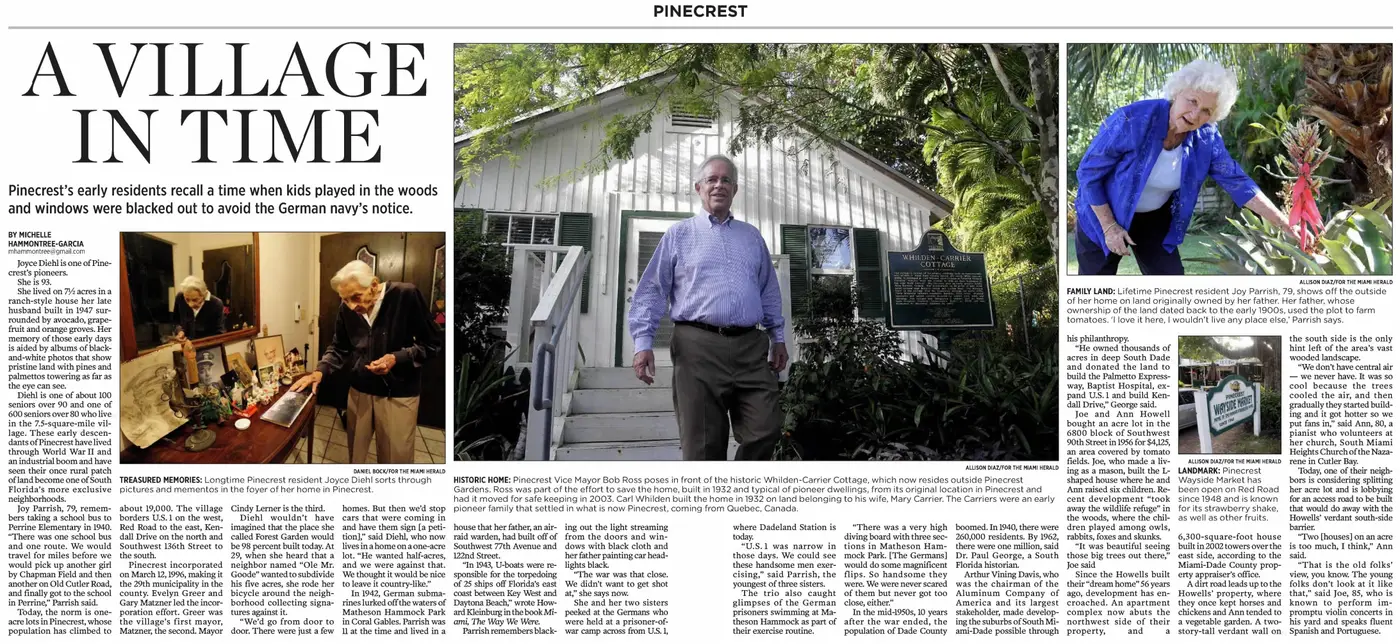
TREASURED MEMORIES: Longtime Pinecrest resident Joyce Diehl sorts through pictures and mementos in the foyer of her home in Pinecrest.
Credit: DANIEL BOCK/FOR THE MIAMI HERALD
HISTORIC HOME: Pinecrest Vice Mayor Bob Ross poses in front of the historic Whilden-Carrier Cottage, which now resides outside Pinecrest Gardens. Ross was part of the effort to save the home, built in 1932 and typical of pioneer dwellings, from its original location in Pinecrest and had it moved for safe keeping in 2003. Carl Whilden built the home in 1932 on land belonging to his wife, Mary Carrier. The Carriers were an early pioneer family that settled in what is now Pinecrest, coming from Quebec, Canada.
Credit: ALLISON DIAZ/FOR THE MIAMI HERALD
FAMILY LAND: Lifetime Pinecrest resident Joy Parrish, 79, shows off the outside of her home on land originally owned by her father. Her father, whose ownership of the land dated back to the early 1900s, used the plot to farm tomatoes. ‘I love it here, I wouldn’t live any place else,’ Parrish says.
Credit: ALLISON DIAZ/FOR THE MIAMI HERALD
LANDMARK: Pinecrest Wayside Market has been open on Red Road since 1948 and is known for its strawberry shake, as well as other fruits.
Credit: ALLISON DIAZ/FOR THE MIAMI HERALD