10 years later, town is a suburban dream
In its first decade, the South Miami-Dade village has become known as a family-oriented municipality, with pricey homes and high-achieving schools.
Pinecrest used to be an area marked by mango farms, pine forests and a few ranch-style homes. Today, as it celebrates its 10th birthday, the village has become an upscale suburban community considered one of Miami-Dade County’s most desireable places to live.
“I think it’s one of those dreams come true kind of things that we did,” Mayor Gary C. Matzner said. “If you build it they will come. And they are coming.”
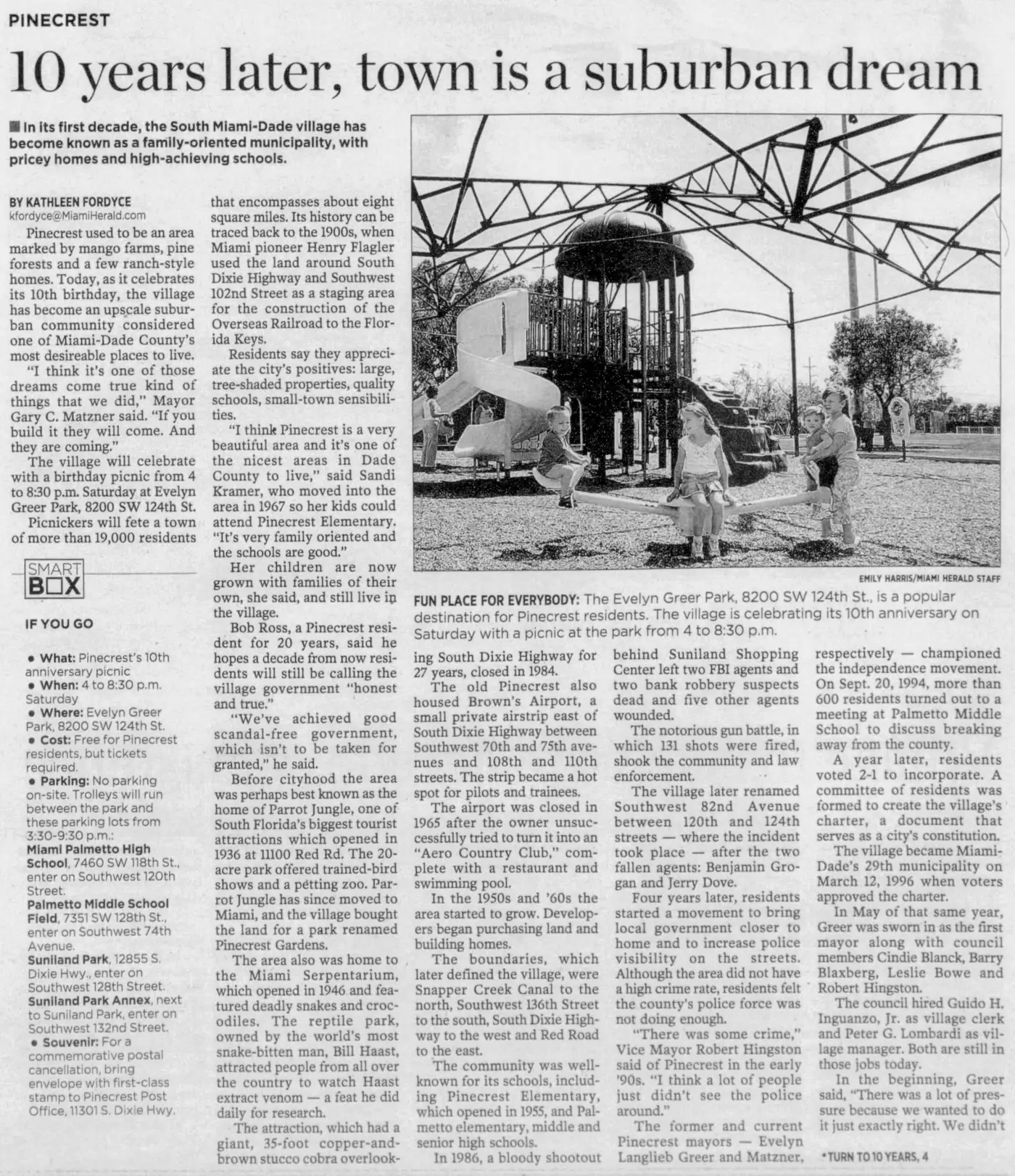
The village will celebrate with a birthday picnic from 4 to 8:30 p.m. Saturday at Evelyn Greer Park, 8200 SW 124th St.
Picnickers will fete a town of more than 19,000 residents that encompasses about eight square miles. Its history can be traced back to the 1900s, when Miami pioneer Henry Flagler used the land around South Dixie Highway and Southwest 102nd Street as a staging area for the construction of the Overseas Railroad to the Florida Keys.
Residents say they appreciate the city’s positives: large, tree-shaded properties, quality schools, small-town sensibilities.
“I think Pinecrest is a very beautiful area and it’s one of the nicest areas in Dade County to live,” said Sandi Kramer, who moved into the area in 1967 so her kids could attend Pinecrest Elementary. “It’s very family oriented and the schools are good.”
Her children are now grown with families of their own, she said, and still live in the village.
Bob Ross, a Pinecrest resident for 20 years, said he hopes a decade from now residents will still be calling the village government “honest and true.”
“We’ve achieved good scandal-free government, which isn’t to be taken for granted,” he said.
Before cityhood the area was perhaps best known as the home of Parrot Jungle, one of South Florida’s biggest tourist attractions which opened in 1936 at 11100 Red Rd. The 20-acre park offered trained-bird shows and a petting zoo. Parrot Jungle has since moved to Miami, and the village bought the land for a park renamed Pinecrest Gardens.
The area also was home to the Miami Serpentarium, which opened in 1946 and featured deadly snakes and crocodiles. The reptile park, owned by the world’s most snake-bitten man, Bill Haast, attracted people from all over the country to watch Haast extract venom - a feat he did daily for research.
The attraction, which had a giant, 35-foot copper-and-brown stucco cobra overlooking South Dixie Highway for 27 years, closed in 1984.
The old Pinecrest also housed Brown’s Airport, a small private airstrip east of South Dixie Highway between Southwest 70th and 75th avenues and 108th and 110th streets. The strip became a hot spot for pilots and trainees.
The airport was closed in 1965 after the owner unsuccessfully tried to turn it into an “Aero Country Club,” complete with a restaurant and swimming pool.
In the 1950s and ’60s the area started to grow. Developers began purchasing land and building homes.
The boundaries, which later defined the village, were Snapper Creek Canal to the north, Southwest 136th Street to the south, South Dixie Highway to the west and Red Road to the east.
The community was well-known for its schools, including Pinecrest Elementary, which opened in 1955, and Palmetto elementary, middle and senior high schools.
In 1986, a bloody shootout behind Suniland Shopping Center left two FBI agents and two bank robbery suspects dead and five other agents wounded.
The notorious gun battle, in which 131 shots were fired, shook the community and law enforcement.
The village later renamed Southwest 82nd Avenue between 120th and 124th streets - where the incident took place - after the two fallen agents: Benjamin Grogan and Jerry Dove.
Four years later, residents started a movement to bring local government closer to home and to increase police visibility on the streets. Although the area did not have a high crime rate, residents felt the county’s police force was not doing enough.
“There was some crime,” Vice Mayor Robert Hingston said of Pinecrest in the early ’90s. “I think a lot of people just didn’t see the police around.”
The former and current Pinecrest mayors - Evelyn Langlieb Greer and Matzner, respectively - championed the independence movement. On Sept. 20, 1994, more than 600 residents turned out to a meeting at Palmetto Middle School to discuss breaking away from the county.
A year later, residents voted 2-1 to incorporate. A committee of residents was formed to create the village’s charter, a document that serves as a city’s constitution.
The village became Miami-Dade’s 29th municipality on March 12, 1996 when voters approved the charter.
In May of that same year, Greer was sworn in as the first mayor along with council members Cindie Blanck, Barry Blaxberg, Leslie Bowe and Robert Hingston.
The council hired Guido H. Inguanzo, Jr. as village clerk and Peter G. Lombardi as village manager. Both are still in those jobs today.
In the beginning, Greer said, “There was a lot of pressure because we wanted to do it just exactly right. We didn’t hire lobbyists, we didn’t pay ourselves any salary, we just wanted it to be a pure democracy. Very idealistic.”
After incorporation, the village quickly took on major capital projects. It resurfaced roadways and installed new street signs to help establish a community identity.
The council also had a portion of South Dixie Highway dedicated as Pinecrest Parkway.
“We hit the ground running,” Hingston said. “We had the financial capability and a good tax base … We had the ability to do a lot of work quickly.”
Since the 1997-98 fiscal year, the village has maintained a lower tax rate than the county. Currently, the rate is $2.40 for every $1,000 of assessed property value.
Bob Ross, the resident who applauds honest government, said: “The first group of elected officials had to deal with a great many issues and those issues have been largely resolved. From here on out, I’m looking for Pinecrest government to maintain what we’ve got. The heavy lifting has been done.”
But Hope Marcus, a Pinecrest resident since 1980, said promises of better police presence and communication between residents and government officials have not been met.
Police are busy wasting taxpayer money ticketing speeders and there is a lot of red tape, she said.
“Incorporation just added another layer of government,” she said. “For example, we’re having a garage sale and I had to go get a permission slip. A permit for a garage sale? Did I need that extra layer of government?”
Marcus said the only good thing that happened since Pinecrest incorporated was that land values increased. But she doesn’t credit the city for that.
“I think land values would have increased anyway,” she said.
In 2000, the village bought Pinecrest Park and renamed it Evelyn Langlieb Greer Park in 2004. The former Parrot Jungle was purchased in 2002. The renamed Pinecrest Gardens has a splash ‘n play area for kids, petting zoo, butterfly exhibit and lush landscaping and trails.
The village also is known for its police department, which started out in 1997 with about 27 sworn officers and has grown to 58.
Pinecrest Police Chief John R. Hohensee, in a report at the beginning of the year, said the crime rate is continuing to decrease - a trend being experienced around most of the county. Last year there were 724 serious crimes, which include robberies, sex crimes and aggravated assaults.
In 2004, the village moved into the $5.5 million, 28,000-square-foot Pinecrest Municipal Center on South Dixie Highway at Southwest 126th Street. The Village Hall houses offices and the police department.
In November 2004, Matzner was elected the village’s second mayor. Council members Nancy L. Harter and Gail D. Serota replaced Blaxberg and Bowe, who retired due to term limits along with Greer.
“I think the number one accomplishment was we created this amazing sense of community,” Greer said.
Miami Herald staff writer Yudy Pineiro contributed to this report.
Photograph
FUN PLACE FOR EVERYBODY: The Evelyn Greer Park, 8200 SW 124th St., is a popular destination for Pinecrest residents. The village is celebrating its 10th anniversary on Saturday with a picnic at the park from 4 to 8:30 p.m.
EMILY HARRIS / MIAMI HERALD STAFF
Smart Box: If You Go
- What: Pinecrest’s 10th anniversary picnic
- When: 4 to 8:30 p.m. Saturday
- Where: Evelyn Greer Park, 8200 SW 124th St.
- Cost: Free for Pinecrest residents, but tickets required.
- Parking: No parking on-site. Trolleys will run between the park and these parking lots from 3:30-9:30 p.m.: Miami Palmetto High School, 7460 SW 118th St., enter on Southwest 120th Street; Palmetto Middle School Field, 7351 SW 128th St., enter on Southwest 74th Avenue; Suniland Park, 12855 S. Dixie Hwy., enter on Southwest 128th Street; Suniland Park Annex, next to Suniland Park, enter on Southwest 132nd Street.
- Souvenir: For a commemorative postal cancellation, bring envelope with first-class stamp to Pinecrest Post Office, 11301 S. Dixie Hwy.