Well-wishers high and dry
Thousands who rely on wells have no power for the pumps
Deck
Thousands who rely on wells have no power for the pumps
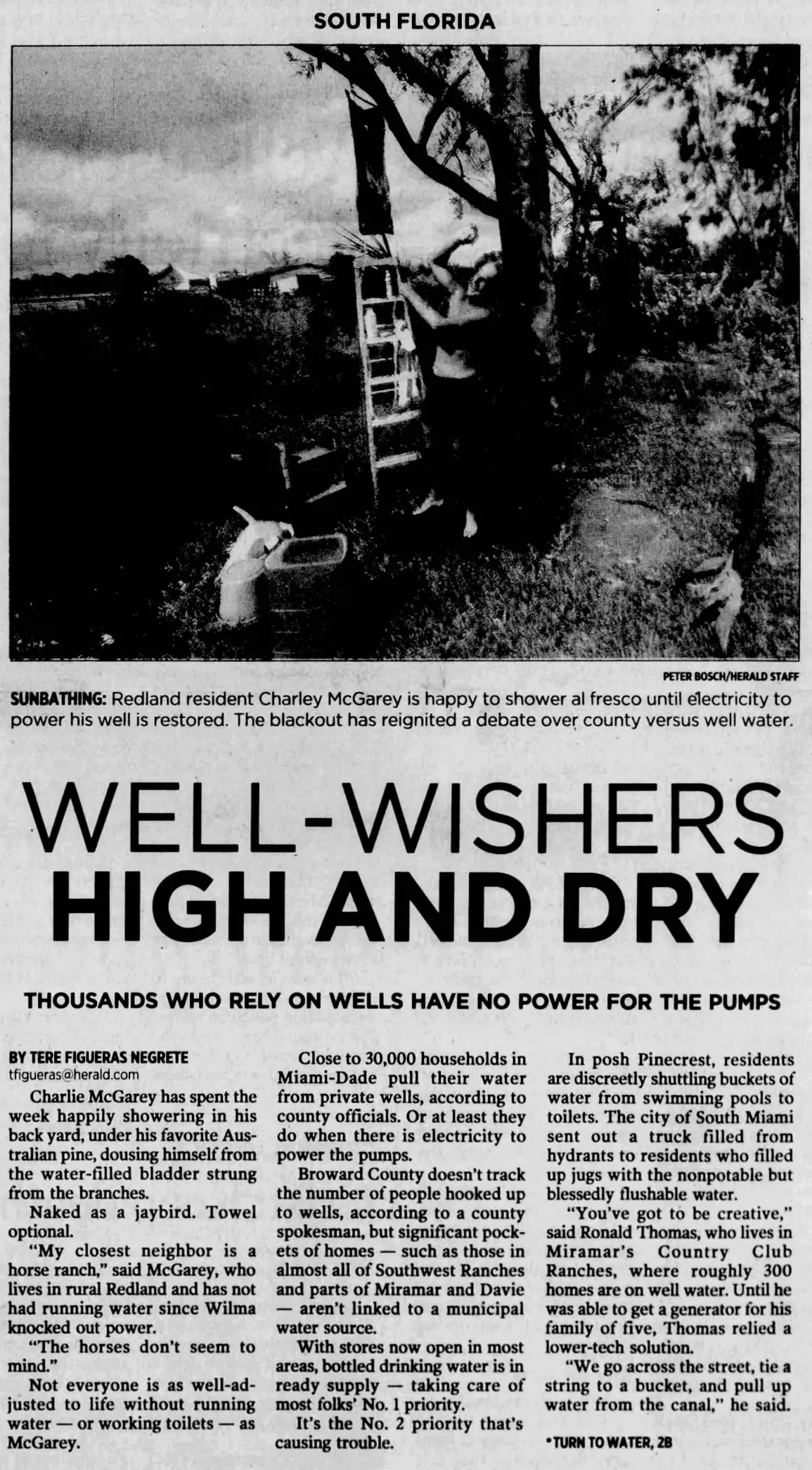
Charlie McGarey has spent the week happily showering in his back yard, under his favorite Australian pine, dousing himself from the water-filled bladder strung from the branches.
Naked as a jaybird. Towel optional.
“My closest neighbor is a horse ranch,” said McGarey, who lives in rural Redland and has not had running water since Wilma knocked out power.
“The horses don’t seem to mind.”
Not everyone is as well-adjusted to life without running water — or working toilets — as McGarey.
Close to 30,000 households in Miami-Dade pull their water from private wells, according to county officials. Or at least they do when there is electricity to power the pumps.
Broward County doesn’t track the number of people hooked up to wells, according to a county spokesman, but significant pockets of homes — such as those in almost all of Southwest Ranches and parts of Miramar and Davie — aren’t linked to a municipal water source.
With stores now open in most areas, bottled drinking water is in ready supply — taking care of most folks’ No. 1 priority.
It’s the No. 2 priority that’s causing trouble.
In posh Pinecrest, residents are discreetly shuttling buckets of water from swimming pools to toilets. The city of South Miami sent out a truck filled from hydrants to residents who filled up jugs with the nonpotable but blessedly flushable water.
“You’ve got to be creative,” said Ronald Thomas, who lives in Miramar’s Country Club Ranches, where roughly 300 homes are on well water. Until he was able to get a generator for his family of five, Thomas relied a lower-tech solution.
“We go across the street, tie a string to a bucket, and pull up water from the canal,” he said.
“In a way, there is a benefit. You realize how other people live. It brings you closer together.”
Low Priority
Some well users may have to resign themselves to daily rationing until electricity is restored — which may take days or even weeks in some areas. Florida Power & Light doesn’t rank those homes among its high-priority cases.
“They’re not on that list, unfortunately,” said FPL spokesman Tom Veenstra, who said residents who rely on wells should stock up on water before a storm hits.
That’s a cold comfort to people who have had to endure even colder baths since last week.
“We’re being extremely friendly to our neighbors who have power, hoping we’ll be invited in for a shower,” said Mecca Fink, mayor of Southwest Ranches, where 98 percent of the 7,000 households are on well water. “They’re very popular now.”
The town is also home to thirsty horses these days, too — including police horses for Pembroke Pines and the Broward Sheriff’s Office. Volunteer firefighters have been making the rounds to local ranches, filling up watering troughs for the equine population.
Ranches and stables in South Dade’s Redland and Kendall’s horse country areas are breaking out generators or greasing up old hand-operated pitcher pumps to pull water from the wells.
In neighborhoods and cities such as Pinecrest, interest in hooking up to a main water supply has run hot and cold over the years.
“It’s a real pain,” said Pinecrest Mayor Gary Matzner, who was so frustrated with his well-water system that he forked over $20,000 when he was rebuilding his home, just to have a water line brought down his street. He was able to recoup some of the cost when neighbors opted for the county’s utility — hook-ups that can run around $5,000, he said.
A little more than a third of Pinecrest’s 4,500 homes are on well water — including the abode of U.S. Rep. Ileana Ros-Lehtinen, who mentioned her problem during a speech about post-Wilma frustrations.
Pinecrest has had an ongoing debate over well water since it incorporated in 1996. Officials have broached the idea of a special assessment to bring county water to the entire area — but they were greeted with strong opposition from neighbors who balked at the cost, said Matzner.
Julie Parlade’s neighbors in Continental Park near Dadeland circulated a petition a few years ago to banish wells for good — but were unsuccessful.
Convert Holdouts
She hopes this latest dry spell will convert the holdouts.
“I hate these wells,” said Parlade, who decamped with her husband and their 2-week-old son to a relative’s home until power was restored. “I never thought about how bad it would be until we lived here.”
But others, like South Dade’s McGarey, see their wells as a source of pride.
He’s content to brush his teeth over a bowl of water, and haul five-gallon jugs from his hand-operated pump to his toilet tank until the power returns to the Redland’s farms and nurseries.
“We know how to survive without the county,” said McGarey. “Thanks but no thanks. We love it just as it is.”
Photograph
Credit: Peter Bosch / Herald Staff
SUNBATHING: Redland resident Charley McGarey is happy to shower al fresco until electricity to power his well is restored. The blackout has reignited a debate over county versus well water.