Critics: Park hijacked for rich
Miami-Dade County taxpayers paid $4 million to acquire and preserve the old Parrot Jungle property for a public park. Critics say they didn't get what was promised.
Printed Page 1B
FORMER PARROT JUNGLE PROPERTY
The old Parrot Jungle property - with its giant stands of cypress and hardwood, limestone sinkholes and eerie blue crabs - was supposed to become a public park when the struggling bird attraction moved from Pinecrest to Watson Island.
Voters agreed to pay $4 million to transform the historic site into a place to picnic and play soccer, as part of a county-wide park bond measure meant to reduce juvenile crime by providing safe places for children to go after school.
Seven years later, county taxpayers do not have the park they were promised but an exclusive setting for elite Pinecrest social functions.
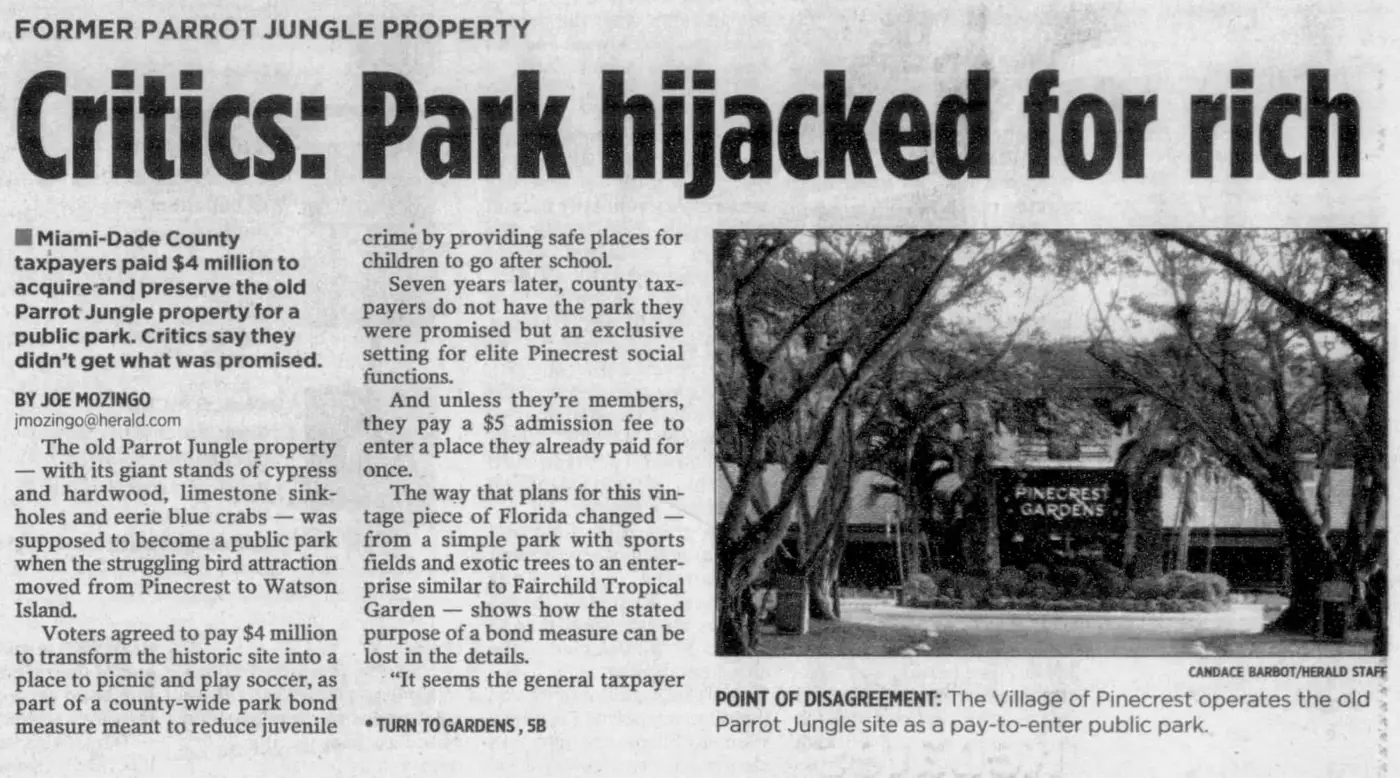
And unless they’re members, they pay a $5 admission fee to enter a place they already paid for once.
The way that plans for this vintage piece of Florida changed - from a simple park with sports fields and exotic trees to an enterprise similar to Fairchild Tropical Garden - shows how the stated purpose of a bond measure can be lost in the details.
“It seems the general taxpayer
Printed instruction: TURN TO GARDENS, 5B
Photograph
POINT OF DISAGREEMENT: The Village of Pinecrest operates the old Parrot Jungle site as a pay-to-enter public park.
Credit: Candace Barbot / Herald Staff
Printed Page 5B
EX-PARROT JUNGLE PROPERTY
Printed marker: GARDENS, FROM 1B
is getting socked for a playground for the rich,” said Martin Levin, a Pinecrest homeowner. “The people that live around Parrot Jungle, in those big houses, they can have their own little private garden, with a [fee] to keep the masses away.”
The new park, called Pinecrest Gardens, is all but empty most days, with more peacocks than cars in the parking lot. On a recent Friday afternoon, a single visitor strolled the lush grounds - and sent startled frogs and turtles leaping into ponds.
But people do visit the gardens on occasion. They go there to attend member-oriented events: corporate receptions, weddings, fundraisers, the “Annual Members Gala,” as well as performances and lectures in which members get “priority seating.”
Attaining The Goal
Through a series of meetings and real estate maneuvers, Pinecrest Mayor Evelyn Greer - with help from County Commissioner Jimmy Morales and county staff - not only turned the public park into a pay-to-play venue but sliced it down in size, The Herald found.
Voters were told that their $4 million dollars would go toward buying the 22-acre Parrot Jungle Property and developing it into a public park.
Instead, Greer and then-County Manager Steve Shiver suggested reducing the county’s interest to less than 14 acres - even though the $4 million cost to county taxpayers stayed the same, records show.
County Attorney Robert Ginsburg on May 31, 2002, advised commissioners that they would have to decide whether such a move was “consistent with the intent of the [Bond] Ordinance.”
Resolution Passes
Yet a month later, with no discussion, commissioners unanimously passed Shiver’s resolution - which made no mention that the property had been reduced in size.
“There should have been some kind of public hearing to make that change,” said Nancy Liebman, president of the Urban Environment League of Greater Miami. “When the bond went to the voters, it meant buying the old Parrot Jungle site, which included everything.”
Voters overwhelmingly passed the Safe Neighborhood Parks Act in November, 1996, agreeing to pay up to $200 million to improve parks and natural areas across the county.
The bond backers made a successful pitch that children needed more sports fields and green spaces to be able to stay out of trouble. Liebman said people need to question whether the “growing phenomenon of public parks charging admission fees” defeats this goal.
In terms of nonmembers, fewer than five children and about 16 adults pay the fee to enter the park on an average day, city records show. The revenues from those $5 fees ($3 for children) support only about 3 percent of the park’s budget.
The rest of the money comes from fundraising and membership fees for the park, which varies depending on how much a member is willing to pay. For instance, a $5,000 membership in the Banyan Society buys “private guided tours for 10 VIP guests,” a catered lunch with the mayor and council, private time with goats and pigs in the petting zoo, and a one-time “complimentary park rental.”
Greer said the memberships were necessary to raise funds and that no one would sign up for membership if admission to the public was free.
Fundraising is done by a nonprofit company, Preserve the Jungle, headed by Greer’s next-door neighbor and political ally, Gary Matzner. The group had hoped to “bid to operate the facility on behalf of the public,” but officials now say the village will run it.
Dade’s Good Fortune
Greer said that overall the county lucked out because the Village of Pinecrest is running and maintaining the park. The village’s estimated cost for next year is $1.3 million, five times more than what it cost Parrot Jungle to maintain the grounds.
She pointed out that the village is developing a fee-based cultural program for the park. Courses include “Afternoon Watercolors,” “Let’s Make a Book,” “Family Yoga,” “Inner Feng Shui,” “Nature Photography” and “Tai Chi.” Fees range from $60 to $170.
“The majority who use the park will not be Pinecrest people,” Greer said. “From our point of view, they got a good deal.”
But how did the county’s interest in the park go from 22 to 14 acres?
If the site were developed as one big, open park - as early plans depicted - children could have played sports on open fields to the west, families could have picnicked on the grass next to Flamingo Lake and strolled under a cool forest canopy.
But Greer wanted to divide the property in such a way that the village could build on part of it.
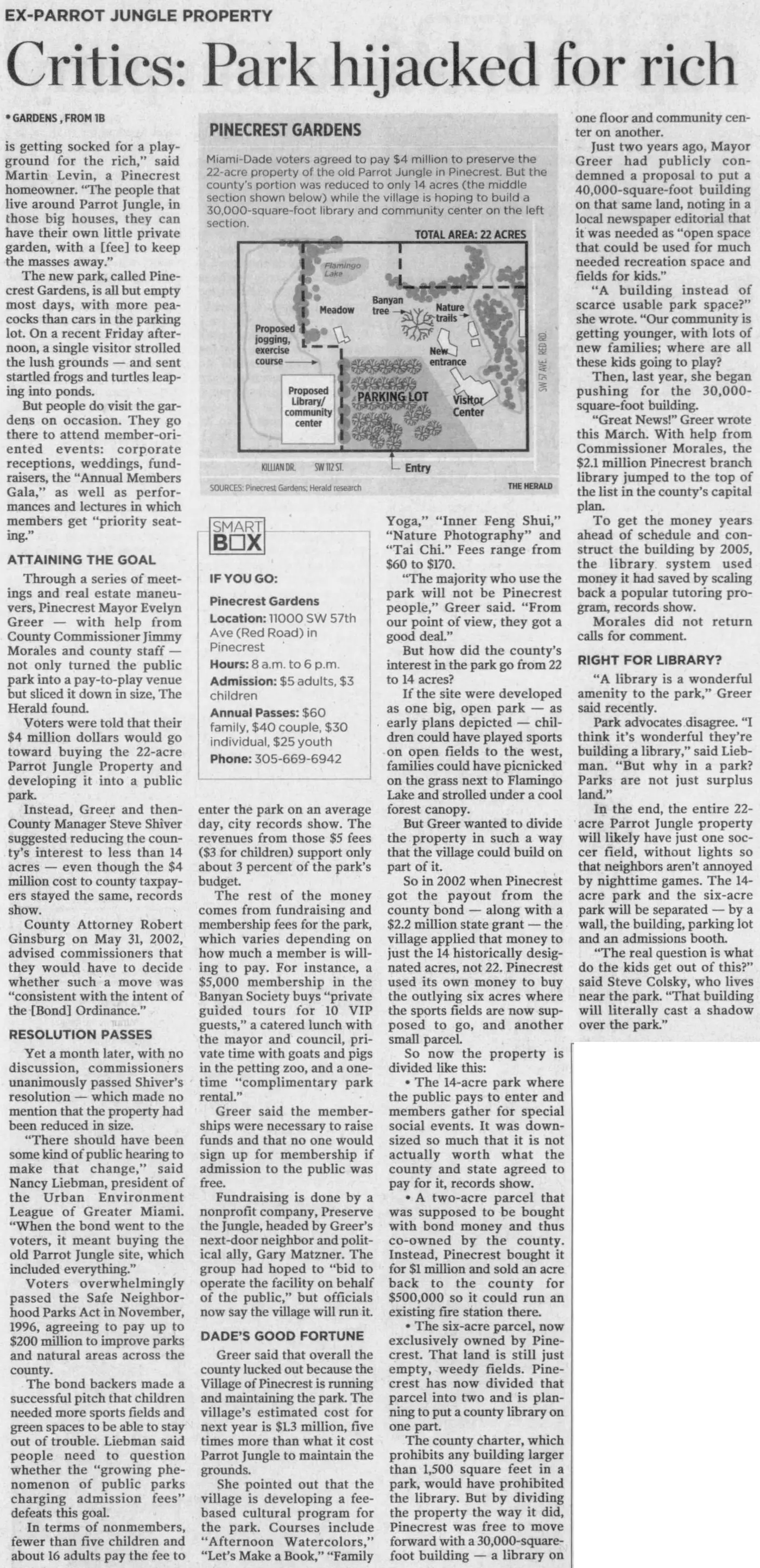
So in 2002 when Pinecrest got the payout from the county bond - along with a $2.2 million state grant - the village applied that money to just the 14 historically designated acres, not 22. Pinecrest used its own money to buy the outlying six acres where the sports fields are now supposed to go, and another small parcel.
So now the property is divided like this:
- The 14-acre park where the public pays to enter and members gather for special social events. It was downsized so much that it is not actually worth what the county and state agreed to pay for it, records show.
- A two-acre parcel that was supposed to be bought with bond money and thus co-owned by the county. Instead, Pinecrest bought it for $1 million and sold an acre back to the county for $500,000 so it could run an existing fire station there.
- The six-acre parcel, now exclusively owned by Pinecrest. That land is still just empty, weedy fields. Pinecrest has now divided that parcel into two and is planning to put a county library on one part.
The county charter, which prohibits any building larger than 1,500 square feet in a park, would have prohibited the library. But by dividing the property the way it did, Pinecrest was free to move forward with a 30,000-square-foot building - a library on one floor and community center on another.
Just two years ago, Mayor Greer had publicly condemned a proposal to put a 40,000-square-foot building on that same land, noting in a local newspaper editorial that it was needed as “open space that could be used for much needed recreation space and fields for kids.”
“A building instead of scarce usable park space?” she wrote. “Our community is getting younger, with lots of new families; where are all these kids going to play?
Then, last year, she began pushing for the 30,000-square-foot building.
“Great News!” Greer wrote this March. With help from Commissioner Morales, the $2.1 million Pinecrest branch library jumped to the top of the list in the county’s capital plan.
To get the money years ahead of schedule and construct the building by 2005, the library system used money it had saved by scaling back a popular tutoring program, records show.
Morales did not return calls for comment.
Right For Library?
“A library is a wonderful amenity to the park,” Greer said recently.
Park advocates disagree. “I think it’s wonderful they’re building a library,” said Liebman. “But why in a park? Parks are not just surplus land.”
In the end, the entire 22-acre Parrot Jungle property will likely have just one soccer field, without lights so that neighbors aren’t annoyed by nighttime games. The 14-acre park and the six-acre park will be separated - by a wall, the building, parking lot and an admissions booth.
“The real question is what do the kids get out of this?” said Steve Colsky, who lives near the park. “That building will literally cast a shadow over the park.”
Pinecrest Gardens Map
Miami-Dade voters agreed to pay $4 million to preserve the 22-acre property of the old Parrot Jungle in Pinecrest. But the county’s portion was reduced to only 14 acres (the middle section shown below) while the village is hoping to build a 30,000-square-foot library and community center on the left section.
TOTAL AREA: 22 ACRES
Labels: Flamingo Lake; Meadow; Banyan tree; Nature trails; Proposed jogging, exercise course; New entrance; Proposed Library/community center; PARKING LOT; Visitor Center; Entry; KILLIAN DR.; SW 112 ST.; SW 57 AVE. (RED RD.).
Historical Visitor Smart Box
IF YOU GO: Pinecrest Gardens
Location: 11000 SW 57th Ave (Red Road) in Pinecrest
Hours: 8 a.m. to 6 p.m.
Admission: $5 adults, $3 children
Annual Passes: $60 family, $40 couple, $30 individual, $25 youth
Phone: 305-669-6942