Pinecrest: To be or not to be a city?
Pinecrest voters will decide Tuesday if they want to form their own city, with its own government and police force - and most importantly, control of its own tax base.
Those who favor a new city say there will be no need to raise taxes, that the neighborhood pays $1.6 million more in taxes than it gets back in services from Metro-Dade County. Police response times will be quicker and zoning decisions will be made locally, they argue.
Opponents of incorporation worry that creating another layer of government will be costly. The only way to increase taxes, they say, is to grow. And since Pinecrest has such little undeveloped land, condominiums and office towers will emerge, tainting the area of single-family homes.
Specifics of Cityhood
Last November, Pinecrest voters overwhelmingly passed a city charter that specified how the village would be governed. It says:
- A seven-member council will include a mayor.
- Pinecrest will be divided into four districts, each represented by a council member. Two other council members and the mayor will be elected at large.
- Council terms will be two years, with a two-term limit.
- The mayor will appoint a full-time village manager, who will have to be approved by the council.
- Voters will have the right to vote on any proposed increase in property taxes.
- Members of the Charter Committee agreed not to run in the first election, April 23.
Anatomy of a Movement
Tuesday’s vote will cap an incorporation movement that began in early 1994. Many in Pinecrest felt their neighborhood was not getting its money’s worth from Metro.
Pinecrest is an affluent, mostly white non-Hispanic neighborhood that runs from Old Cutler Road west to U.S. 1 between Kendall Drive and Southwest 136th Street.
The 1990 census set the median household income for the area’s 5,722 homes at $87,717.
Incorporation advocates based part of their argument on the fact that its 19,000 residents were paying $9.4 million in taxes and receiving only $7.8 million in services.
“We’re giving more than $1.5 million away,” Pinecrest Charter Commission member Gary Matzner said. “We’re a donor community, with excess taxes.”
Attorney Gene Stearns, who guided Key Biscayne through its incorporation and is working with East Kendall as it tries to become a city, had friends who lived in Pinecrest.
‘You Should Do This’
“Gene basically said, ‘You should do this,’ ” said Evelyn Greer, a leading advocate for incorporation. “He said, ‘You guys are crazy, you should start to do this.’ ”
Greer, who has said she will run for mayor if Pinecrest becomes a city, and Matzner got things started by gathering 600 signatures on a petition seeking incorporation.
In September 1994, a county-approved study confirmed that Pinecrest could support itself and was in fact sending more money the county’s way than it was getting back in services.
Last September, almost half the eligible voters participated in the first vote on incorporation, with 65 percent supporting it. The turnout was greater than in Key Biscayne and Aventura.
“People have come a long way in understanding,” Greer said.
Beginnings of Dissent
And last November, the village’s charter was drafted - ironically helping lead to the first concerted effort to block the incorporation.
Armando Lacasa and a small group of homeowners worried that incorporation would lead to an increase in taxes formed the Concerned Homeowners of Pinecrest.
“Because of inflation, there will be problems five or more years down the road,” Lacasa said. “Pinecrest will have to grow upward because there is nowhere to grow outward.”
Incorporation proponents said some Key Biscayne residents also feared tax increases before their vote in 1990. But property taxes have decreased for three consecutive years.
Key Biscayne Vice Mayor John Waid said his village has prospered since incorporating. And he doesn’t see any reason Pinecrest wouldn’t do the same.
“It depends on their ability to save money,” he said. “If they can provide more services for less money, then it’s worthwhile. Their tax base is probably high enough that they could provide services for less money than the county can give to them.”
Incorporation: Pro and Con
Yes
Here are four reasons the Pinecrest Committee for Incorporation, represented by Evelyn Greer, the leading advocate for incorporation, believes voters should choose to form their own village:
- Police protection: The goal of incorporation is to dramatically increase the cruising patrol cars in our area. Our budget provides for an increase from three patrol cars per shift to 13 patrol cars per shift. Deterrence, not response time, is the issue.
- Zoning: Zoning decisions will be locally controlled. Zoning hearings will be at night at City Hall on U.S. 1. Our Village Council will be Pinecrest residents. The incorporation leadership has fought density for years - now Pinecrest has the ability to control its own growth.
- Beauty: Stop graffiti, clear vacant lots, plant trees.
- Response of local government: There are too many requirements, and downtown is too big a bureaucracy. With a local government, when you make a complaint, someone will actually respond.
Portrait caption: Greer.
No
Here are four reasons opponents of Pinecrest incorporation, represented by attorney Richard Brodsky, believe voters should reject forming their own village:
- Bureaucracy: Under the proposed Pinecrest budget, the Village of Pinecrest will start with a bureaucracy fit for a large city. These things, and all other campaign promises will cost money. Where will it come from?
- Taxes: Pinecrest will lack the tax base to generate the tax revenues needed to fund the size and scale of municipal government that has been promised.
- Expansion: Pinecrest has very little vacant land and has no place to expand. Pinecrest will have to raise taxes down the line, just to support the Pinecrest municipal bureaucracy.
- Police protection: We don’t have to create a municipality to put more police on the street. We can create a special taxing district. This will add to the protection we’re already receiving, instead of starting from scratch.
Portrait caption: Brodsky.
Photographs and Captions
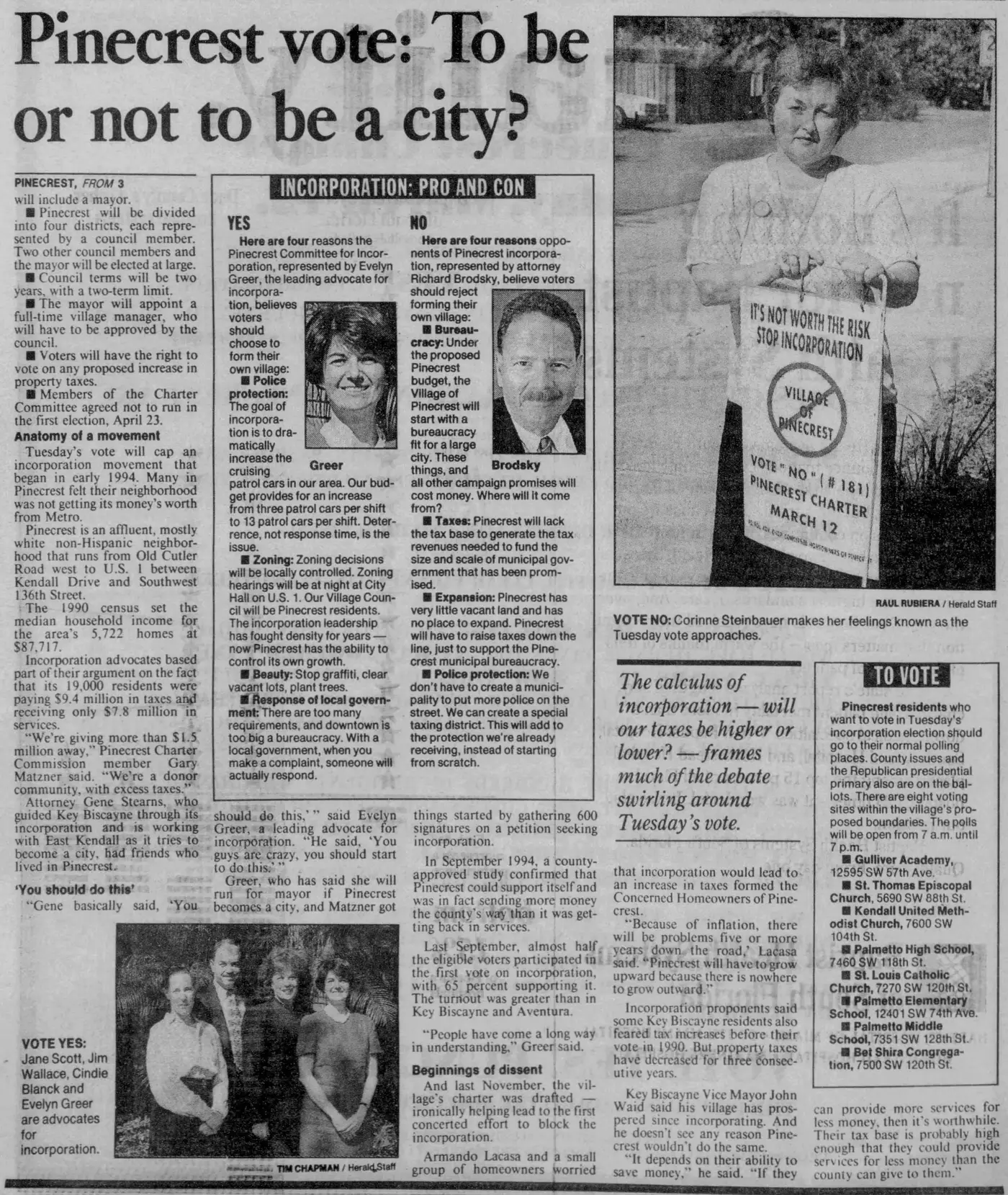
VOTE NO: Corinne Steinbauer makes her feelings known as the Tuesday vote approaches.
Credit: RAUL RUBIERA / Herald Staff.
Visible sign: IT’S NOT WORTH THE RISK / STOP INCORPORATION / VILLAGE OF PINECREST / VOTE “NO” (# 181) / PINECREST CHARTER / MARCH 12. Small footer text on the sign is not reliably legible and is not transcribed.
VOTE YES: Jane Scott, Jim Wallace, Cindie Blanck and Evelyn Greer are advocates for incorporation.
Credit: TIM CHAPMAN / Herald Staff.
Pull Quotation
The calculus of incorporation - will our taxes be higher or lower? - frames much of the debate swirling around Tuesday’s vote.
To Vote
Pinecrest residents who want to vote in Tuesday’s incorporation election should go to their normal polling places. County issues and the Republican presidential primary also are on the ballots. There are eight voting sites within the village’s proposed boundaries. The polls will be open from 7 a.m. until 7 p.m.
- Gulliver Academy, 12595 SW 57th Ave.
- St. Thomas Episcopal Church, 5690 SW 88th St.
- Kendall United Methodist Church, 7600 SW 104th St.
- Palmetto High School, 7460 SW 118th St.
- St. Louis Catholic Church, 7270 SW 120th St.
- Palmetto Elementary School, 12401 SW 74th Ave.
- Palmetto Middle School, 7351 SW 128th St.
- Bet Shira Congregation, 7500 SW 120th St.
Continuation Furniture
Page 3K marker: PLEASE SEE PINECREST, 6. Page 6K label: PINECREST AT A CROSSROAD. Page 6K headline: Pinecrest vote: To be or not to be a city? Page 6K marker: PINECREST, FROM 3.