Voters split on cityhood
Yes: Pinecrest; No: Destiny
Yes: Pinecrest; No: Destiny
Sabrina Walters and Ana Acle Chasko, Herald Staff Writers. The Miami Herald, September 20, 1995, printed 1A and 12A, Final Edition / F*.
Voters gave Dade’s incorporation craze a split verdict Tuesday, with one community choosing to form a new city and another opting to stay with Metro-Dade.
In the North Dade region dubbed Destiny, voters shied away from cityhood, apparently fearing higher taxes. In the South Dade hamlet of Pinecrest, voters chose overwhelmingly to patrol their own streets, collect their own taxes and care for their own parks.
Tuesday’s vote seemed to suggest that incorporation is a good thing as long as you can afford it.
Voters in Pinecrest, one of Dade’s most affluent areas, approved incorporation by a 2-1 margin, with 66 percent favoring it. Nearly half of the area’s registered voters participated.
“It’s not an issue of rich or poor, or white or black,” said Gary Matzner, a pro-cityhood leader. “It’s an issue of providing better services for tax dollars.”
It was a closer but still definitive vote in Destiny, where leaders had hoped to establish a majority-black city free of Metro’s control. Voters seemed to reject the grand idea in favor of their pocket books.
“Common sense tells me that taxes will go up,” said Fred Young, a North Dade resident and leader of the fight to kill Destiny. “You can’t start something new without start-up costs.”
Destiny is less wealthy than Dade as a whole, and several Metro reports said the area, with 43,000 residents, receives more in government services than it pays for. The same studies predicted that a new city would cost more money.
Shirley Gibson, a Destiny leader, called Tuesday a “sad day.”
“We worked hard to bring our people together and bring government closer,” she told a group of supporters. “Unfortunately, the campaign was waged on higher taxes, and that wasn’t what it was all about.”
About 56 percent of those voting in Destiny opposed incorporation, while nearly 44 percent favored it. About 31 percent of registered voters turned out.
‘Foolish prospect’
Misty Lakes North condo owner Patricia Williams said she’s content with the way her neighborhood is being run.
“It’s totally ridiculous to make this Destiny,” said Williams, who has lived in unincorporated Dade for 27 years. “No system of government is perfect, and the one we have already works. It’s a foolish prospect.”
Completely invisible Tuesday night: Wayne Huizenga, owner of Joe Robbie Stadium. He adamantly opposed becoming part of Destiny but kept a low profile. A new city would have had enormous leverage over the stadium — everything from taxes to parking to fireworks.
Tuesday’s mixed result in Pinecrest and Destiny clouded the future of what once seemed like an unstoppable political trend toward smaller government.
Earlier this year, residents in more than a half-dozen communities took the first steps toward incorporation. The movement fed on frustration with Metro-Dade, an elephantine government that critics say responds slowly to neighborhood problems.
In Aventura earlier this year, voters opted overwhelmingly to break away from Metro. They vote in November on a city charter, the final step. Residents in East and West Kendall, Sunny Isles, Doral and Palmetto South are considering cityhood bids.
Isolating poorer areas?
Not everyone has embraced incorporation fever. Many people worry that a rush to secede by Dade’s wealthier communities will further isolate Dade’s poorer communities and leave them with inadequate public services.
Pinecrest’s secession would mean a property tax loss to Dade County of $10 million annually.
The area’s drive for cityhood fed on a desire for safer streets and slower growth. The movement’s leaders were able to convince many residents that a new city would make a real difference in their lives.
“I like the idea of running your own police and taking care of your own zoning,” said resident Luis Gonzalez, 41.
Pinecrest must still overcome several obstacles before it can open its own city hall. Metro commissioners could now appoint a citizens’ panel to draw up a new city charter, and that charter must be approved by Pinecrest voters. At any point along the way, Metro commissioners could kill the plan.
Pinecrest leaders hope to be able to offer quality services at roughly the same cost as Metro. Some residents said they would be willing to pay more for better services.
Metro planning director Guillermo Olmedillo said he thought it would be difficult for Pinecrest to hold the line on taxes.
“My gut feeling is that to maintain the same level of services, they will have to raise taxes,” Olmedillo said.
Pinecrest leaders say their city will become a model for the county.
“When neighboring communities see police out on the streets in Pinecrest, taxes going down, potholes getting fixed and more school crossing guards, it will send a strong message,” Matzner said.
Pull Quotation
Destiny’s voters said they feared a break with Metro-Dade would hike their taxes.
Photograph And Caption
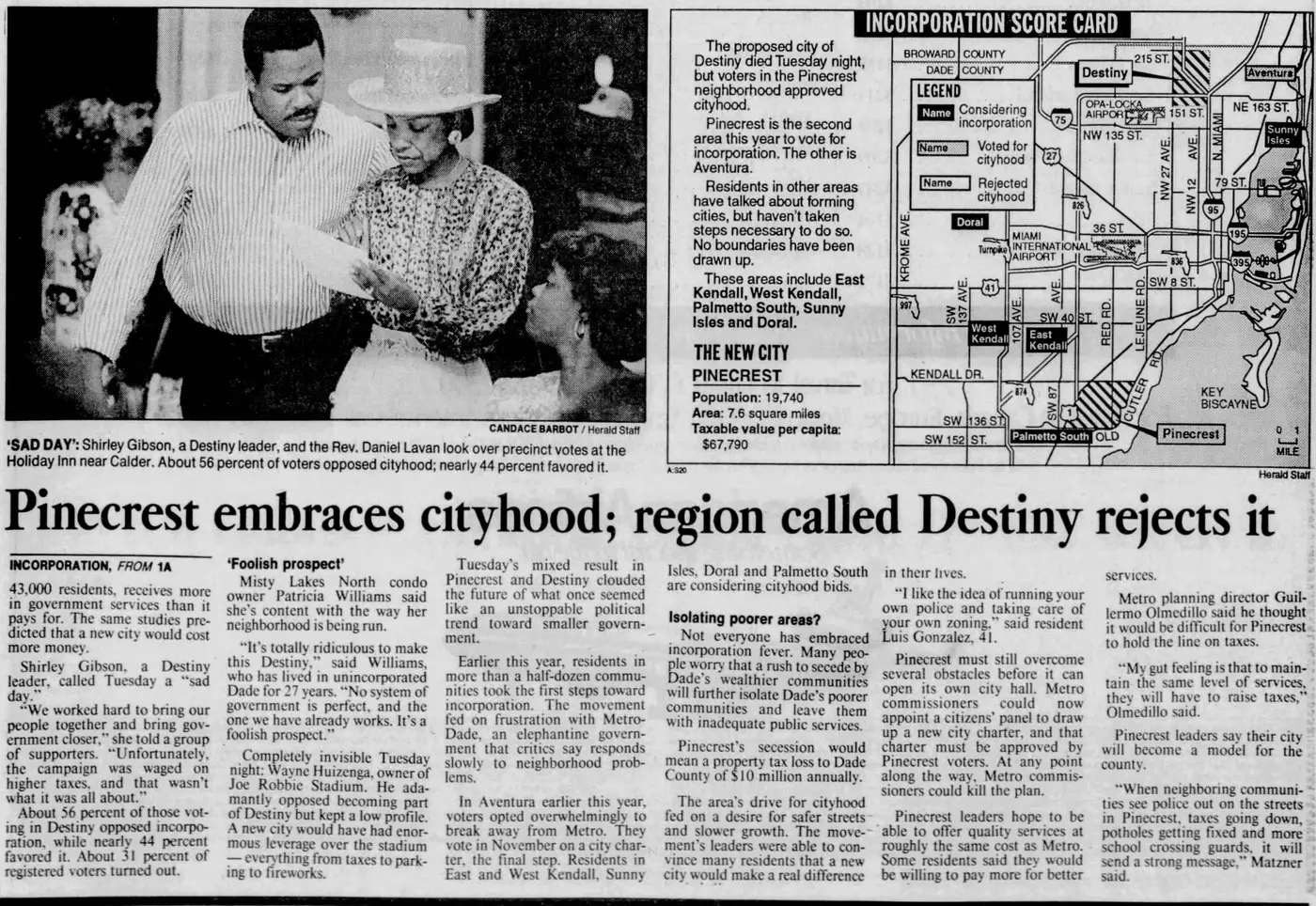
‘SAD DAY’: Shirley Gibson, a Destiny leader, and the Rev. Daniel Lavan look over precinct votes at the Holiday Inn near Calder. About 56 percent of voters opposed cityhood; nearly 44 percent favored it.
Candace Barbot / Herald Staff. Neither identified person is Gary.
Incorporation Score Card
The proposed city of Destiny died Tuesday night, but voters in the Pinecrest neighborhood approved cityhood.
Pinecrest is the second area this year to vote for incorporation. The other is Aventura.
Residents in other areas have talked about forming cities, but haven’t taken steps necessary to do so. No boundaries have been drawn up.
These areas include East Kendall, West Kendall, Palmetto South, Sunny Isles and Doral.
The New City: Pinecrest
- Population: 19,740
- Area: 7.6 square miles
- Taxable value per capita: $67,790
Map
Legend: Considering incorporation; Voted for cityhood; Rejected cityhood.
Labeled proposal areas: Destiny, Aventura, Sunny Isles, Doral, West Kendall, East Kendall, Palmetto South, Pinecrest. Geographic reference labels: Broward County, Dade County, Opa-locka Airport, Miami International Airport, Key Biscayne. Readable roads and routes: 215 St.; 151 St.; NW 135 St.; NE 163 St.; NW 27 Ave.; NW 12 Ave.; N. Miami; 79 St.; 36 St.; SW 8 St.; SW 40 St.; Kendall Dr.; SW 136 St.; SW 152 St.; Old Cutler Rd.; LeJeune Rd.; Krome Ave.; Red Rd.; SW 137 Ave.; SW 107 Ave.; SW 87; Turnpike; 1, 27, 41, 75, 95, 195, 395, 826, 836, 874, 997. One vertical road label reads only AVE.; no number supplied. Scale: 0-1 mile. Map credit: Herald Staff. Map graphic retained for spatial context; this label inventory is not a reconstruction of boundary geometry.