The dash for incorporation
As cities multiply, Dade is ever more divided
The dark green chunks on the map are the richest neighborhoods. Next come the light green, then yellow, orange and red. If things keep going the way they’re going, there will be a lot of green on the move in Dade County.
Kendall, Pinecrest, Aventura. Many of Metro’s most affluent communities want out. They intend to make themselves into cities, taking their frustrations, their ambitions and their healthy tax revenues with them.
Is there anything wrong with that?
It depends on your point of view. No one disputes the right of communities to choose to govern themselves. That is, after all, the founding principle of the United States. The question is what happens afterward.
Critics worry that when the most affluent are gone, the pain of life will increase for those left behind. Adherents to the gospel of incorporation counter that the answer is not fewer cities, but more.
The helter-skelter drive to incorporate is making blood boil and voices rise. It’s an often messy scuffle over finance and ethics, rights and responsibilities. For better or worse, it threatens to change the shape of Metro government.
“It’s a disaster that Metro has brought on itself,” said Dan Paul, who wrote the county charter nearly 40 years ago. He thinks it’s time that Metro focused on large countywide tasks — utilities, mass transit, code enforcement — and left local policing and zoning to smaller communities.
Yet Paul also frets that the drive to create new cities in Metro’s backwash carries the risk of creating too much duplication in taxes and services — which is why Metro was created in the first place.
Metro-Dade, as counties go, is big. It’s the biggest municipal government south of Washington and east of Dallas. The $3.9 billion it will spend this year is larger than the budgets of 12 states.
Smaller is better in the view of groups that want to turn slices of Metro into cities. They believe that local government has become too distant from the people in a county where there are twice as many state legislators (26) as county commissioners (13).
“When I moved here, my taxes paid for what I thought were adequate services. Since then, my taxes have increased threefold, and services have gone down,” says Pinecrest resident Leonard Carrier. “I think incorporation is the only answer.”
Six communities
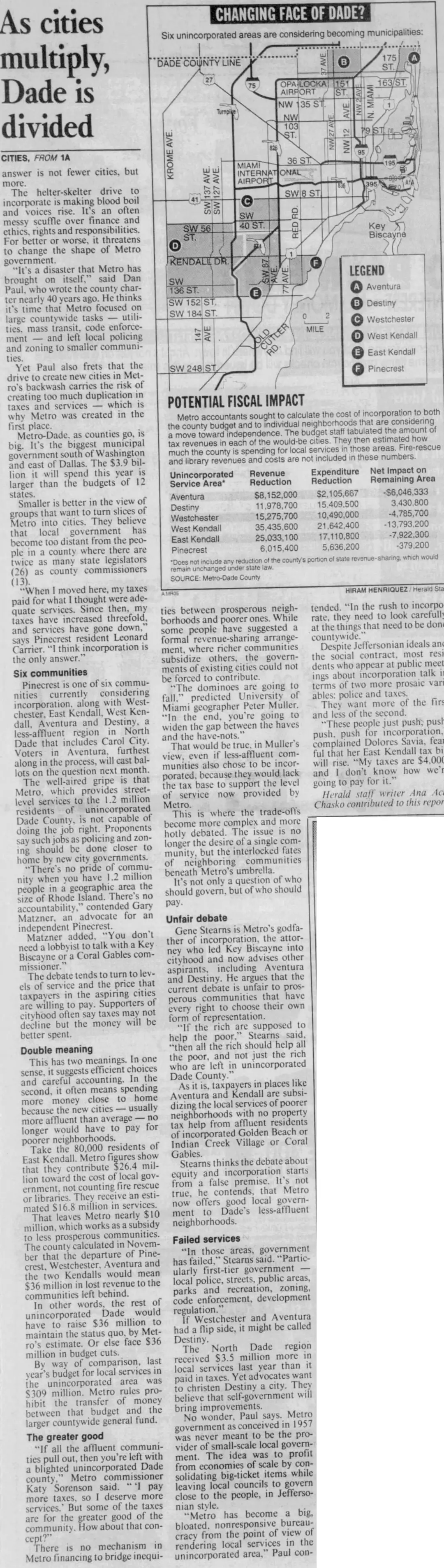
Pinecrest is one of six communities currently considering incorporation, along with Westchester, East Kendall, West Kendall, Aventura and Destiny, a less-affluent region in North Dade that includes Carol City. Voters in Aventura, furthest along in the process, will cast ballots on the question next month.
The well-aired gripe is that Metro, which provides street-level services to the 1.2 million residents of unincorporated Dade County, is not capable of doing the job right. Proponents say such jobs as policing and zoning should be done closer to home by new city governments.
“There’s no pride of community when you have 1.2 million people in a geographic area the size of Rhode Island. There’s no accountability,” contended Gary Matzner, an advocate for an independent Pinecrest.
Matzner added, “You don’t need a lobbyist to talk with a Key Biscayne or a Coral Gables commissioner.”
The debate tends to turn to levels of service and the price that taxpayers in the aspiring cities are willing to pay. Supporters of cityhood often say taxes may not decline but the money will be better spent.
Double meaning
This has two meanings. In one sense, it suggests efficient choices and careful accounting. In the second, it often means spending more money close to home because the new cities — usually more affluent than average — no longer would have to pay for poorer neighborhoods.
Take the 80,000 residents of East Kendall. Metro figures show that they contribute $26.4 million toward the cost of local government, not counting fire rescue or libraries. They receive an estimated $16.8 million in services.
That leaves Metro nearly $10 million, which works as a subsidy to less prosperous communities. The county calculated in November that the departure of Pinecrest, Westchester, Aventura and the two Kendalls would mean $36 million in lost revenue to the communities left behind.
In other words, the rest of unincorporated Dade would have to raise $36 million to maintain the status quo, by Metro’s estimate. Or else face $36 million in budget cuts.
By way of comparison, last year’s budget for local services in the unincorporated area was $309 million. Metro rules prohibit the transfer of money between that budget and the larger countywide general fund.
The greater good
“If all the affluent communities pull out, then you’re left with a blighted unincorporated Dade county,” Metro commissioner Katy Sorenson said. “‘I pay more taxes, so I deserve more services.’ But some of the taxes are for the greater good of the community. How about that concept?”
There is no mechanism in Metro financing to bridge inequities between prosperous neighborhoods and poorer ones. While some people have suggested a formal revenue-sharing arrangement, where richer communities subsidize others, the governments of existing cities could not be forced to contribute.
“The dominoes are going to fall,” predicted University of Miami geographer Peter Muller. “In the end, you’re going to widen the gap between the haves and the have-nots.”
That would be true, in Muller’s view, even if less-affluent communities also chose to be incorporated, because they would lack the tax base to support the level of service now provided by Metro.
This is where the trade-offs become more complex and more hotly debated. The issue is no longer the desire of a single community, but the interlocked fates of neighboring communities beneath Metro’s umbrella.
It’s not only a question of who should govern, but of who should pay.
Unfair debate
Gene Stearns is Metro’s godfather of incorporation, the attorney who led Key Biscayne into cityhood and now advises other aspirants, including Aventura and Destiny. He argues that the current debate is unfair to prosperous communities that have every right to choose their own form of representation.
“If the rich are supposed to help the poor,” Stearns said, “then all the rich should help all the poor, and not just the rich who are left in unincorporated Dade County.”
As it is, taxpayers in places like Aventura and Kendall are subsidizing the local services of poorer neighborhoods with no property tax help from affluent residents of incorporated Golden Beach or Indian Creek Village or Coral Gables.
Stearns thinks the debate about equity and incorporation starts from a false premise. It’s not true, he contends, that Metro now offers good local government to Dade’s less-affluent neighborhoods.
Failed services
“In those areas, government has failed,” Stearns said. “Particularly first-tier government — local police, streets, public areas, parks and recreation, zoning, code enforcement, development regulation.”
If Westchester and Aventura had a flip side, it might be called Destiny.
The North Dade region received $3.5 million more in local services last year than it paid in taxes. Yet advocates want to christen Destiny a city. They believe that self-government will bring improvements.
No wonder, Paul says. Metro government as conceived in 1957 was never meant to be the provider of small-scale local government. The idea was to profit from economies of scale by consolidating big-ticket items while leaving local councils to govern close to the people, in Jeffersonian style.
“Metro has become a big, bloated, nonresponsive bureaucracy from the point of view of rendering local services in the unincorporated area,” Paul contended. “In the rush to incorporate, they need to look carefully at the things that need to be done countywide.”
Despite Jeffersonian ideals and the social contract, most residents who appear at public meetings about incorporation talk in terms of two more prosaic variables: police and taxes.
They want more of the first and less of the second.
“These people just push, push, push, push for incorporation,” complained Dolores Savia, fearful that her East Kendall tax bill will rise. “My taxes are $4,000, and I don’t know how we’re going to pay for it.”
Herald staff writer Ana Acle Chasko contributed to this report.
Map And Table
CHANGING FACE OF DADE? Six unincorporated areas are considering becoming municipalities: A, Aventura; B, Destiny; C, Westchester; D, West Kendall; E, East Kendall; F, Pinecrest. Map depicts proposed areas and geographic/road labels; consult the preserved image for boundaries rather than treating these as current municipal limits.
POTENTIAL FISCAL IMPACT
Metro accountants sought to calculate the cost of incorporation to both the county budget and to individual neighborhoods that are considering a move toward independence. The budget staff tabulated the amount of tax revenues in each of the would-be cities. They then estimated how much the county is spending for local services in those areas. Fire-rescue and library revenues and costs are not included in these numbers.
| Unincorporated Service Area* | Revenue Reduction | Expenditure Reduction | Net Impact on Remaining Area |
|---|---|---|---|
| Aventura | $8,152,000 | $2,105,667 | -$6,046,333 |
| Destiny | 11,978,700 | 15,409,500 | 3,430,800 |
| Westchester | 15,275,700 | 10,490,000 | -4,785,700 |
| West Kendall | 35,435,600 | 21,642,400 | -13,793,200 |
| East Kendall | 25,033,100 | 17,110,800 | -7,922,300 |
| Pinecrest | 6,015,400 | 5,636,200 | -379,200 |
Does not include any reduction of the county’s portion of state revenue-sharing, which would remain unchanged under state law.